
NimbleWork

ADLC (Agentic Delivery Lifecycle): How AI Agents Are Reshaping the Sprint

ADLC (Agent Delivery Lifecycle) is a modern software delivery framework where AI agents and human teams work together.

It compresses specification, development, and QA timelines while improving quality and team satisfaction.

Unlike traditional SDLC, ADLC treats AI agents as intelligent collaborators that handle repetitive, detailed work so humans can focus on strategy.

Introduction

For two decades, the Software Development Lifecycle (SDLC) hasn’t fundamentally changed. Requirements are written, then specifications, then code, then testing—each phase dependent on the clarity and rigor of the last. 

Studies show that specification quality is one of the strongest predictors of development success. Teams with high-quality specifications experience up to 60% fewer defects, 40% faster delivery, and 45% lower rework costs compared to teams working from ambiguous or poorly-written requirements.

With AI agents, at every phase, compress the timeline and eliminate the toil. The result: faster delivery andhigher quality. Teams finally have time to think strategically instead of drowning in syntax.

This is ADLC for software teams.

In this guide, we’ll define ADLC, show you how it differs from traditional SDLC and give you a practical five-stage roadmap to adopt it in your organization.

What is ADLC (the Agent Delivery Lifecycle)?

ADLC is a modern software delivery framework that integrates AI agents as core contributors at every stage of product development. It spans planning, specification, development, quality assurance, and deployment, with human oversight at every critical gate.

ADLC is a hybrid model. It means it’s neither like traditional SDLC, which is purely human-driven (and slow), nor pure “no-code/AI-generated-everything” approaches (which are unreliable). Here, humans set strategy and direction; AI agents execute high-quality, consistent, repeatable work; humans review and refine.

What ADLC is NOT

ADLC is not SDLC with AI tools added. It is a different operating model — redesigned for a world where the primary execution unit is an agent, not a human. – ADLC Manifesto

ADLC is not traditional software delivery with AI added to a few tasks. It is not simply faster coding, automated testing, or a collection of disconnected copilots. Nor does it mean handing the entire delivery process to autonomous agents.

It redesigns delivery around a clear division of responsibility: agents handle repeatable execution, while people retain control over intent, priorities, risk, governance and accountability.

The goal is NOT to remove humans from delivery,  but to help them operate with better judgment and faster decision-making.

Key phases of ADLC:

  1. Define: Humans define the business outcome, constraints, success signals and acceptable risk. So, set goals, context and guardrails for AI agents to analyze roadmap, risks, and team capacity to recommend priorities.
  2. Create: AI agents draft detailed specifications, stories, acceptance criteria, and BDD scenarios from high-level requirements. Agents translate intent into plans, requirements, code, tests, documentation and delivery artifacts.
  3. Verify: Agent outputs are continuously evaluated for quality, functionality, security and alignment with expected outcomes. 
  4. Oversee: Humans make the decisions that require context and accountability like priorities, exceptions, risk, policy and strategic alignment.
  5. Release/Deploy: Move changes into production safely. Agents orchestrate releases, feature flags, environment promotion and rollback within human-defined controls.
  6. Learn: Agents monitor usage, behavior, failures and business outcomes. Those signals feed back into the next intent and generation cycle.
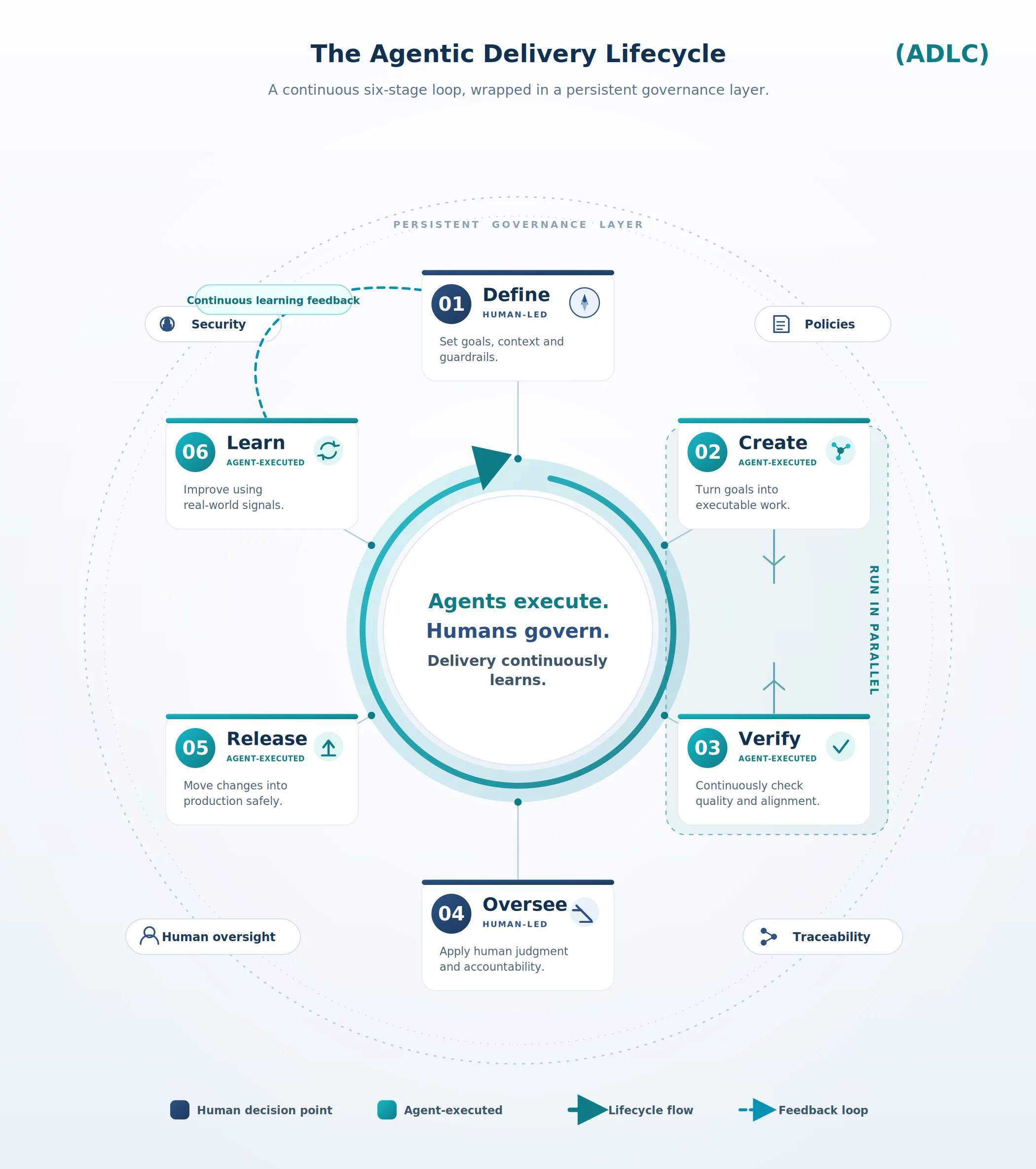
Image showing ADLC phases

                                       Created with AI

The key idea is:

“Agents execute. Humans govern. Delivery continuously learns.”

With that, let’s look in detail on the stages of the agentic delivery lifecycle.

How does ADLC work? And how does NimbleWork support it? 

The Agentic Delivery Lifecycle is not a rigid handoff from one stage to the next. It is a continuous loop in which agents generate and evaluate work, people retain control over consequential decisions, and real delivery signals influence what happens next.

In practice:

  • Define and Oversee are primarily human-led.
  • Create and Verify contain the highest level of agent-led execution.
  • Release combines automation with human-controlled approvals.
  • Learn connects operational evidence back to the next Define stage

Step 1: Define 

Set the outcome, context and boundaries for delivery.

Every agentic initiative should begin with a clearly expressed intent. Teams establish the business outcome they want to achieve, the customer problem being addressed, how success will be measured and the constraints within which agents can operate.

This includes defining:

  • Business and customer outcomes
  • Scope and requirements
  • Success measures and acceptance conditions
  • Budget, timeline and resource constraints
  • Security, compliance and data boundaries
  • Decisions agents may make independently
  • Actions that require human approval

Agents can analyse source documents, uncover requirements and identify missing information, but they should not decide the organization’s priorities or risk tolerance. Those decisions remain with people.

How NimbleWork supports this stage

  • Elaborator — turns a card title into a role-aware description, capturing intent in usable form
  • AI Suggest — flags similar workitems across projects, so scope isn’t duplicated or missed
  • Intelligent Hub — conversational querying to pull in context and existing knowledge. 
  • Supporting: AI Coach (surfaces best-practice guardrails), Smart Board (converts a rough board image into proposed lanes — early structuring)
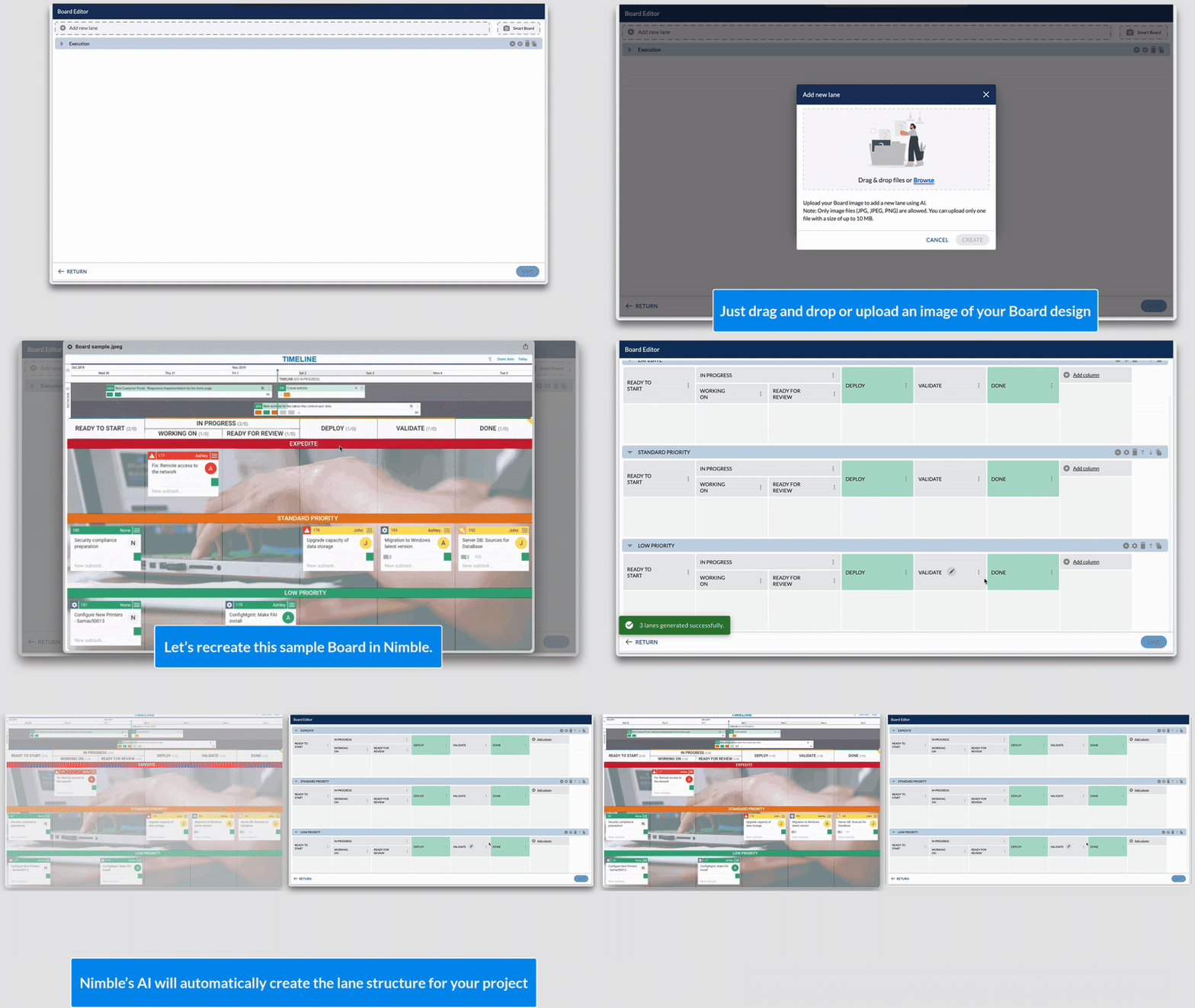
The output at this stage is a delivery contract that tells agents what to achieve, what boundaries to respect and when to return control to a human

Step 2: Create

Turn approved intent into executable work.

Agents convert high-level goals into the artifacts required for execution. Depending on the initiative, these could include plans, features, user stories, descriptions, task breakdowns, acceptance criteria, test scenarios and supporting documentation.

Rather than waiting for people to prepare every artifact manually, agents can create an initial version in seconds. People then review, refine and approve the generated work. This changes the team’s role from producing every detail to directing and improving what agents produce.

How NimbleWork supports this stage

  • Smart-Task: Breaks a card into an actionable checklist of To-Dos.
  • Smart-Fill: Recommends and populates configured field values based on the workitem’s name and description, improving completeness and consistency. Learn about Smart-Fill.
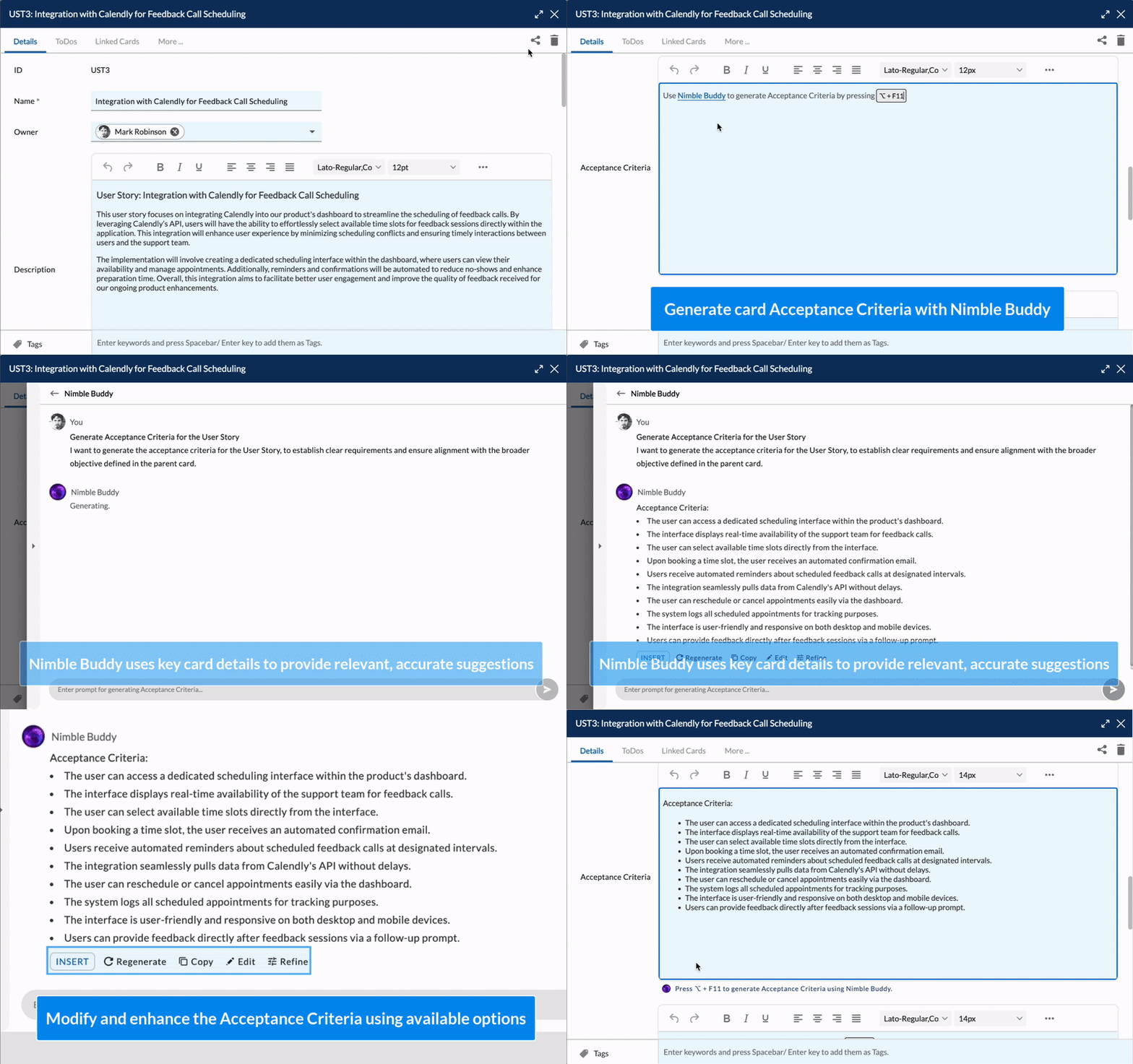
  • Smart-Acceptance: Generates specific, actionable acceptance criteria so teams have a clearer definition of completion.
  • Smart-BDD: Converts requirements into Behavior-Driven Development scenarios in Gherkin format, connecting business expectations with validation logic.
  • Smart Board: Converts a rough board image into proposed digital lanes that users can review and modify before saving.
  • AI Assist: Helps users perform in-application actions such as retrieving information, updating cards and logging time through conversational requests.
  • Work Hub: Gives teams a common delivery environment in which generated work can be organized, assigned and executed.
  • Intelligent Planning: generates plans, timelines, workload distribution
  • Supporting: Work Hub (the environment where generated work is organized and executed)
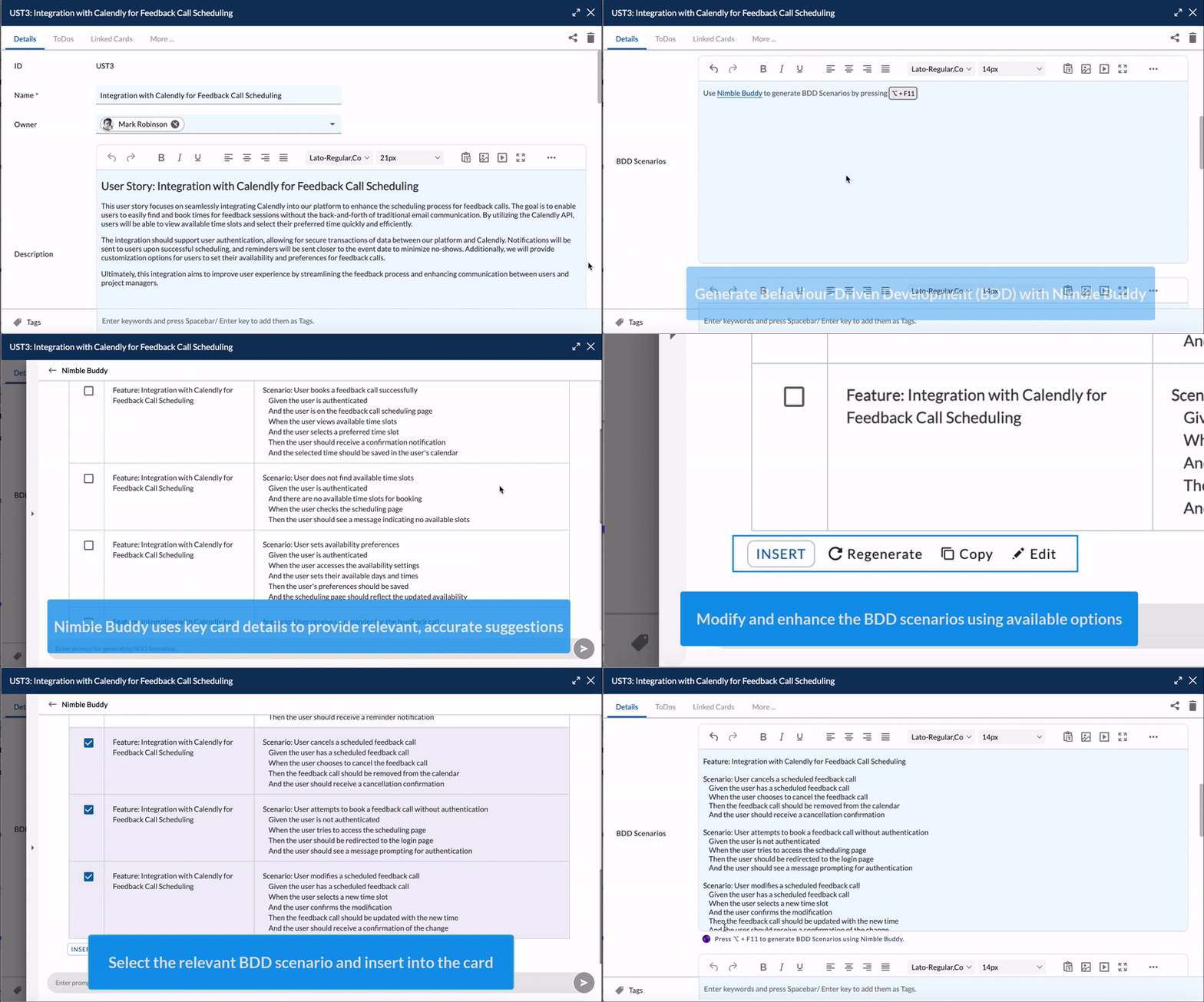
Nimble’s AI Agents can help generate descriptions, acceptance criteria, To-Dos, BDD scenarios, comment summaries and test cases within the normal workitem flow. Explore Nimble’s AI Agents

The goal is not to accept every generated artifact automatically. It is to reduce blank-page work while preserving human review where context and judgment matter.

Step 3: Verify

Continuously check quality, completeness and alignment.

Verification in ADLC occurs whenever an agent produces something important.

Generated requirements must be checked for clarity. Plans must be checked for missing dependencies. User stories must be testable.

Code and configurations must satisfy functional, security and policy requirements. Outcomes must also be compared with the original intent.

Verification can involve multiple layers:

  • Requirement completeness
  • Acceptance-criteria coverage
  • Functional testing
  • Behavioural testing
  • Security and compliance checks
  • Dependency and risk validation
  • Human review of high-impact outputs

How NimbleWork supports this stage

  • Test-Gen — auto-creates test cases with steps and expected results (functional testing)
  • Smart-BDD — the behavioural-testing layer; Gherkin links business expectations to validation logic
  • Smart-Acceptance — provides the acceptance-criteria coverage that verification checks against
  • Supporting: AI Suggest (duplication/overlap checks).
The important shift is that verification happens alongside creation. Agents generate; automated and human checks evaluate; agents revise; and people intervene when judgment or accountability is required.

Step 4: Oversee

Apply human judgment, governance and accountability.

Agentic delivery does not eliminate management or governance. It makes them more important.

During Oversee, leaders monitor whether work remains aligned with its intended outcomes and whether agents are operating within approved boundaries. People resolve exceptions, approve material changes, accept risk and intervene when business context cannot be reduced to a rule.

Oversee should answer questions such as:

  • Is the initiative still aligned with the intended outcome?
  • Are cost, schedule and scope within acceptable limits?
  • Which dependencies or risks require intervention?
  • Are agents following established processes and policies?
  • Where is human approval required?
  • Should the plan, priority or release decision change?

How Nimble supports this stage

  • Executive Summary: Analyses selected dashboard data, identifies trends, anomalies and areas requiring attention, and converts them into a natural-language summary with supporting visuals.
  • Summarizer — condenses long comment threads and discussions for decision-makers
  • Business Rules: Allows administrators to define triggers, conditions, actions and execution frequency. Rules can automate controlled actions such as updating or blocking cards when established criteria are met. 

The Executive Summary and other AI capabilities can surface what requires attention. They should support—not replace—the person accountable for the final decision.

Step 5: Release

Move verified work into use through controlled delivery.

Release is where completed work reaches customers, internal users or production environments. In an agentic model, agents may coordinate routine release activities, update work states, communicate status or trigger connected workflows. However, the level of autonomy should depend on the organization’s risk profile.

A release should account for:

  • Readiness and acceptance status
  • Outstanding defects and risks
  • Dependencies across teams and systems
  • Available team capacity
  • Release scope and timing
  • Required approvals
  • Rollback or recovery plans
  • Communication with affected stakeholders

How NimbleWork supports this stage

  • AI Assist — updates work states, logs activity, coordinates in-app release actions
  • Supporting: Intelligent Planning (capacity/readiness), Work Hub (execution environment)

Nimble’s role here is primarily to coordinate release scope, readiness, dependencies and visibility. It should not be positioned as a replacement for a CI/CD or production deployment platform.

Release is therefore not “agents push everything automatically.” It is controlled progression based on verified evidence and predefined authority.

Step 6: Learn

Use real delivery signals to improve the next cycle.

After release, teams compare actual results with the original intent. They examine not only whether the work was delivered, but whether it produced the expected customer, operational and business outcomes.

The signals can include:

  • Customer adoption and feedback
  • Defects and production incidents
  • Cycle time and throughput
  • Delivery predictability
  • Delays, spillover and blocked work
  • Team feedback and sentiment
  • Outcome and OKR progress
  • Patterns from previous projects and releases

Agents can collect, analyse and summarize these signals. People interpret their significance, decide what should change and convert those findings into new priorities, constraints or experiments. Those decisions then return to the Define stage.

How NimbleWork supports this stage

  • Analytics: Metrics such as throughput, flow efficiency, cycle time, time lost to blocking, velocity, burnup, burndown and spillover help teams understand how work actually moved.
  • Executive Summary AI Agent: Identifies patterns, deviations and areas requiring attention across dashboard data.
  • Supporting: AI Suggest (patterns from previous projects), AI Coach (turns patterns into next-cycle guidance). 

The Learn stage completes the lifecycle only when those insights alter the next definition of intent. Without that feedback loop, ADLC becomes faster execution, not continuously improving delivery.

NimbleWork’s role across ADLC is to connect intent, agent-generated work, human governance and delivery intelligence in one managed environment.

SDLC vs. ADLC: what actually changes

SDLC phase

ADLC stage

What actually changes

Requirements & Specification

Define → Create

In SDLC, an analyst writes the spec over weeks. In ADLC, people set intent (outcomes, scope, guardrails, risk tolerance) and agents draft the specification from source documents in a first pass that people review. The work shifts from writing the spec to directing it.

Story & Acceptance Criteria Generation

Create

Stories and acceptance criteria are generated by agents and refined by the team, rather than hand-written from scratch. The definition of done arrives with the story, not after it.

Development

Create (execution) — parallel with Verify

The coding work is the same, but there are fewer clarification loops because acceptance criteria are explicit up front. Verification runs alongside development, not as a later gate.

QA, Testing & Automation

Verify — parallel with Create

Testing stops being a downstream phase. Agents generate test cases and behavioural checks as work is created, so defects surface during the build instead of at the end.

Deployment

Release

Agents coordinate routine release steps like state updates, status communication, connected workflows, within limits people approve. Autonomy scales to the organization’s risk profile.

(no SDLC equivalent)

Oversee

SDLC has no dedicated governance phase; oversight is implicit and ad hoc. ADLC makes it continuous. Humans monitor alignment, approve material changes, and accept risk throughout the flow.

(no SDLC equivalent)

Learn

SDLC typically ends at deployment. ADLC adds a closing loop: agents collect delivery signals, people interpret them, and the findings become the next Define.


The key idea is:

The real change in agentic delivery is that Development and QA stop being sequential with governance wrapping everything that SDLC never had.

Final thoughts on ADLC

The shift from SDLC to ADLC moves the work people do up a level — from writing every spec, story, and test to setting intent and deciding what the delivery signals mean. Agents draft; humans direct.

The change is structural. Development and QA stop running in sequence and become a parallel Create/Verify band. Governance becomes a continuous layer, not an afterthought. And a Learn stage — the one thing SDLC never had — turns real outcomes back into sharper intent for the next cycle.

No tool installs this for you. ADLC rewards teams that define their process clearly enough for agents to work inside it. That’s the model NimbleWork is built around: agents execute, humans govern, delivery keeps learning

FAQs

Q1: What exactly is the Agentic Delivery Lifecycle (ADLC)?

ADLC is a software delivery framework where AI agents execute and humans govern at every phase. It compresses timelines while improving quality and team satisfaction. Unlike traditional SDLC (purely human-driven) or pure AI automation (unreliable), ADLC is hybrid: humans set strategy; AI handles repetitive, detailed work; humans review and refine.

Q2: How is ADLC different from traditional Agile or Waterfall SDLC?

Traditional SDLC is linear and human-driven: product managers write specs, developers code, QA tests. Each phase depends on the clarity of the previous one. ADLC is parallel and hybrid: AI agents draft specs, tests, and code scaffolds based on high-level input; humans review and refine. Result: 50–60% faster, higher quality, fewer clarifications. The core Agile principles (iteration, feedback, collaboration) remain; the tooling and team dynamics shift.

Q3: Will AI agents replace developers, product managers, and QA engineers?

No. ADLC removes rote, detailed work from humans so they can focus on strategy, creativity, and problem-solving. Developers stop debugging unclear specs and start architecting systems. PMs stop writing acceptance criteria and start talking to customers. QA engineers stop manually writing test cases and start discovering edge cases. Jobs don’t disappear; they become more strategic and satisfying.

Q4: What are the main risks of adopting ADLC?

Key risks: (1) Over-reliance on AI without human review; (2) Poor domain knowledge fed to AI agents; (3) Team resistance; (4) Implementation time. Mitigation: Start with a pilot, invest in domain knowledge bases and prompt templates, be transparent with your team about goals, measure progress.

Q5: How long does it take to implement ADLC across an organization?

For a pilot (one feature): 8–12 weeks. For full organizational rollout: 3–6 months. The timeline depends on team size, feature complexity, and how quickly your templates stabilize. Most organizations see ROI within 2–3 months of piloting. 

Q6: Can we use ADLC for non-software projects (marketing campaigns, infrastructure, operations)?

Yes. ADLC is delivery framework-agnostic. Marketing teams can use it to generate campaign briefs and content outlines. Infrastructure teams can use it to generate deployment specifications and runbooks. Operations teams can use it for incident response playbooks. The principle is the same: AI agents handle detailed, repetitive planning and documentation; humans focus on strategy.

Q7: How does NimbleWork support ADLC specifically?

NimbleWork’s AI Agents module is built for ADLC end-to-end. Intelligent Planning for roadmap optimization, Smart-Acceptance for criteria generation, Smart-BDD for test scenario creation, Test-Gen for test automation, and Sentiment Analysis for team health monitoring. Unlike tools that bolt AI on top, NimbleWork integrates AI agents as core contributors to your delivery workflow. You get orchestrated AI, not isolated tools.

Q8: What’s the expected ROI from adopting ADLC?

Measured in several ways: (1) Time savings: 50–60% faster delivery = delivering 2–3x more features per quarter. (2) Quality: 70% less rework due to spec ambiguity = fewer firefighting sprints. (3) Team satisfaction: 30% improvement in job satisfaction = lower turnover, better retention. (4) Cost: Fewer hours on spec writing, QA automation, and rework = 20–30% cost savings per feature. NimbleWork customers report ROI within 2–3 months of full adoption.

Exit mobile version