



Sprint planning is one of the foundational ceremonies in Agile and Scrum frameworks. It sets the stage for how a team will deliver value in a focused timebox known as a sprint. According to the Scrum Guide, Sprint Planning is a timeboxed event that kicks off the sprint by laying out the work to be performed for the upcoming sprint. Its purpose is to ensure the Scrum Team aligns around a clear Sprint Goal and understands how to achieve it.
Why does sprint planning matter so much? In a Forbes Tech Council article, experts point out that effective sprint planning leads to better prioritization of work based on business and user impact, improving the team’s ability to deliver value consistently. Additionally, teams that leverage data-driven approaches in planning, such as historical velocity and work-in-progress limits, report significantly improved accuracy and throughput.
This article is designed for Scrum Masters, Product Owners, or Agile team members who are new to sprint planning. We’ll break down the process into clear, actionable steps so you can get your team aligned quickly and start delivering value with confidence.
1. What is Sprint Planning?
Sprint planning is a collaborative session that marks the beginning of every sprint. Typically held at the start of the sprint cycle, the meeting involves the Scrum Team coming together to decide what work will be done and how it will be accomplished. It results in the creation of a Sprint Backlog and a shared understanding of the Sprint Goal.

The meeting is timeboxed to a maximum of eight hours for a one-month sprint, and proportionately shorter for shorter sprints. For example, a two-week sprint usually has a 2-4 hour planning session. The goal is not to over-plan but to ensure enough clarity and commitment to start the sprint with momentum.
Key outputs of this meeting include:
- A clearly defined Sprint Goal
- A selected set of Product Backlog items
- A high-level plan on how the selected work will be completed
2. Who Should Attend Sprint Planning?
Sprint Planning is a whole-team activity. The following roles must be present:
- Product Owner (PO): Presents the prioritized backlog and explains the business context of each item.
- Scrum Master (SM): Facilitates the session, ensures Scrum principles are followed, and helps remove blockers.
- Development Team: Provides input on what can realistically be achieved and how it will be implemented.
In some cases, stakeholders or subject matter experts may be invited to clarify requirements, but their participation is typically limited to the start of the meeting.


3. Key Inputs Needed Before the Meeting
Preparation is half the battle when it comes to sprint planning. Here are the essential inputs:
- Prioritized Product Backlog: Items should be ordered by business value, urgency, and feasibility.
- Refined User Stories: Stories should meet the Definition of Ready (DoR), with clear acceptance criteria and estimates.
- Team Capacity: Account for vacations, holidays, and other commitments. Many teams also reserve a buffer (e.g., 10-20%) for unexpected work.
- Historical Velocity: Knowing your average sprint velocity helps set realistic expectations.
- Sprint Goal Draft: An initial idea of what the sprint should achieve helps frame the planning conversation.
4. The Sprint Planning Agenda
To structure the planning session efficiently, split it into two parts:
A. What Can Be Delivered in the Sprint?
In this segment, the team decides what work they will commit to.
- The Product Owner walks through the top-priority backlog items.
- The team discusses dependencies, risks, and estimates.
- Based on historical velocity and capacity, the team selects backlog items they believe can be completed.
B. How Will the Work Be Done?
Once the sprint backlog is finalized, the focus shifts to execution:
- Break down user stories into actionable tasks.
- Identify technical requirements, blockers, or test strategies.
- Assign or self-organize tasks within the team.
- Confirm all selected stories meet the Definition of Done (DoD).
5. Tips to Run a Successful Sprint Planning Meeting
Here are best practices to ensure your session is productive:
- Groom the backlog beforehand: Don’t waste time estimating or clarifying stories during the planning session.
- Use data-driven decision-making: Leverage metrics like cycle time, WIP, and velocity.
- Time-box discussions: Stick to a schedule to avoid dragging out the session.
- Encourage participation: Use techniques like round-robin or planning poker to engage everyone.
- Visualize the plan: Use a digital board or physical whiteboard to show story flow and capacity.
6. Common Pitfalls to Avoid
Avoid these common mistakes that can derail your planning:
- Unrefined backlog items: Leads to confusion and rework.
- PO domination: Planning should be a team activity, not a monologue.
- Overcommitting: Pushing beyond the team’s capacity results in spillover and missed goals.
- Skipping risk identification: Surprises during the sprint can derail timelines.
- No task breakdowns: This leaves work vague and hard to track.
7. Setting the Sprint Goal
The Sprint Goal acts as a north star for the team.
What makes a good Sprint Goal?
- Specific and achievable
- Focused on user or business value
- Not just a list of tasks
Examples:
- “Enable users to reset passwords via mobile app”
- “Reduce API response time by 20%”
A strong goal helps in trade-off decisions during the sprint and provides a clear narrative for stakeholders.
8. What Happens After Sprint Planning?
Once planning is complete:
- The team starts the sprint with a shared understanding of what needs to be done.
- Daily standups begin to track progress.
- Work is visualized on boards (Kanban or Scrum boards).
- Burndown charts or cumulative flow diagrams track progress.
At the end of the sprint, the team reviews their work in a Sprint Review and reflects on improvements in the Sprint Retrospective.
9. Nimble’s Sprint Planning Feature
Nimble’s Sprint Planning feature is designed to streamline and simplify sprint preparation. The tool brings together Product Owners, Scrum Masters, and Development Teams to collaboratively plan work with clarity and efficiency.
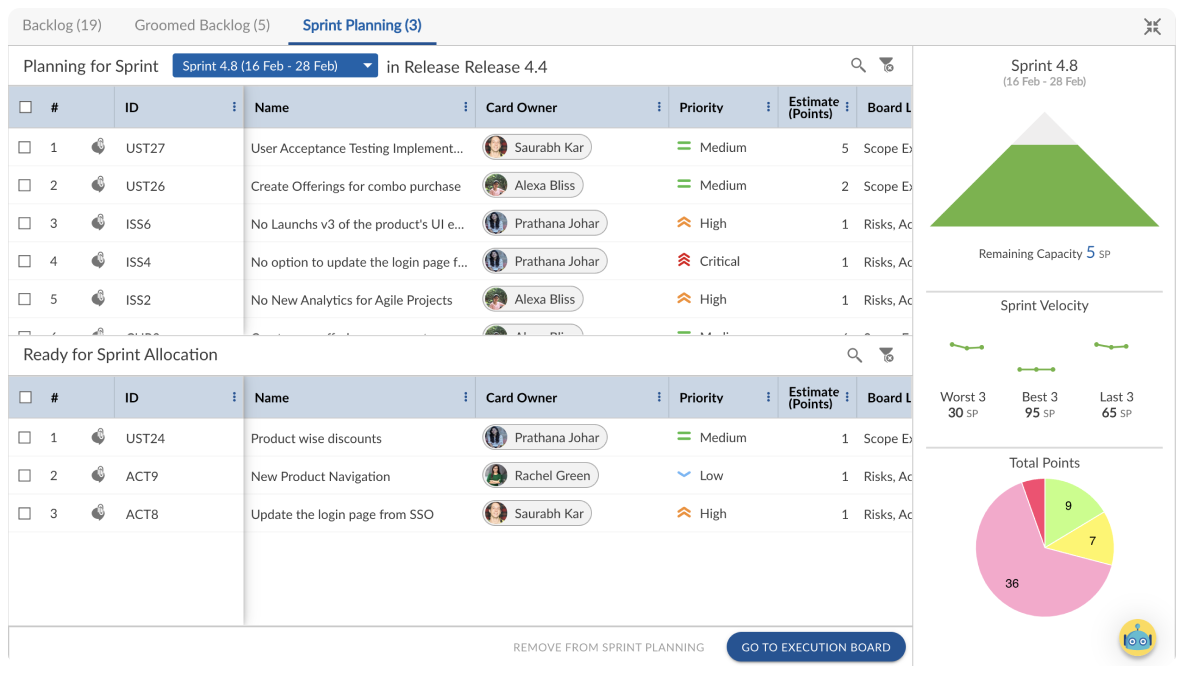

Key Capabilities of Nimble Sprint Planning:
- Dedicated Sprint Planning Menu: Unlike the Backlog Refinement menu, this view allows you to plan multiple sprints side-by-side.
- Drag-and-Drop Interface: Move workitems from the backlog to sprints with a simple drag-and-drop.
- Capacity Planning: Select units of measurement (UOM) such as story points or card count to set and monitor team capacity. Visual indicators help ensure you don’t over-plan.
- Edit Sprint Details: Modify sprint start/end dates, capacity, and view performance metrics of previous sprints (best 3, worst 3, last 3).
- Multiple Views: Switch between Card View for task-level detail or Tree View for a visual size comparison of workitems.
- Toolbar Utilities: Use filters, zoom, and full-screen modes to customize your planning experience.
- Add Cards Instantly: Quickly add new workitems during the planning session.
By combining visual planning, capacity management, and historical performance insights, Nimble enables faster and more effective sprint planning while keeping everyone aligned on goals and workloads.
10. Tools That Can Help
Effective planning requires the right tools. Consider:
- NimbleWork: Integrated sprint boards, backlog grooming, and velocity tracking.
- Jira: Offers reporting tools like velocity charts and sprint planning templates.
- Miro/Mural: Great for remote whiteboarding and collaborative planning.
- Planning Poker Apps: Useful for distributed story point estimation.
11. Conclusion
Sprint planning is more than just a meeting it’s a strategic opportunity to align your team, set direction, and commit to delivering value. When done well, it provides clarity, boosts morale, and drives performance.
Preparation, participation, and a clear structure are the pillars of a great sprint planning session. With tools like NimbleWork, your team can reduce time spent planning and increase time delivering.
Ready to get started? Try Nimble’s sprint planning to make your next planning session fast, focused, and frustration-free.