


AI in ecommerce is no longer just about chatbots; it’s beyond them.
People talk about personalization, and “the future of retail” but you get examples like product recommendations or search improvements. Both are useful, but neither fully captures where AI creates practical value for ecommerce teams today.
The most useful applications sit inside workflows that shape the customer journey and the team’s day-to-day operations across:
- product discovery,
- support,
- merchandising,
- order communication, and
- decision-making.
And, the strongest use cases do two things at once: they make the shopping experience smoother for customers and reduce manual work for internal teams.
AI should be evaluated by its ability to move core ecommerce metrics like conversion, revenue per visitor, margin, and time-to-launch.
Which is why this guide focuses on 7 practical AI in ecommerce use cases that improve both customer experience and operations—and that can realistically move from experimentation into implementation.
What is AI in ecommerce?
AI in ecommerce refers to the use of artificial intelligence to improve how online stores attract, serve, and retain customers while helping internal teams work more efficiently. In practice, that means using AI to make decisions or automate tasks that would otherwise require constant manual effort.
On the customer side, AI in ecommerce can improve product discovery, search relevance, recommendations, support responses, and post-purchase communication. On the operations side, it can help teams with merchandising, product content, demand signals, customer insights, and service workflows.
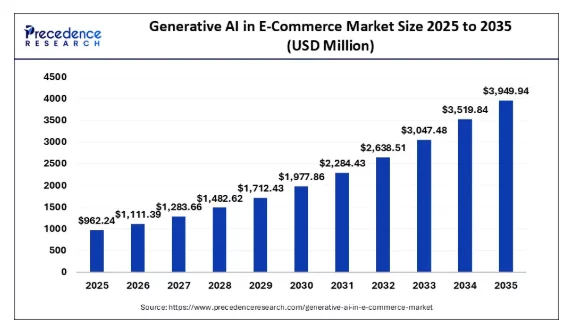

Source: Precedence Research
What makes an AI use case worth implementing in e-commerce?
Not every AI idea deserves to become a project.
The best e-commerce AI use cases are not isolated experiments. They improve the actual moments where customers drop off, ask questions, hesitate, or need reassurance.
A strong AI use case in e-commerce usually:
- solves a recurring friction point
- improves a measurable metric
- fits into an existing workflow
- does not require a total stack rebuild
- can be governed safely
One crucial fact: Quality of customer data.
The quality of the data determines whether AI improves over time or stalls. And, choosing use cases based on where they affect the funnel most like discovery, comparison, confidence, post-purchase retention, or operations is essential.
That is a useful way to think about prioritization.
Here’s a mini checklist that you can use to identify a high-impact AI use case:
- Does this use case remove friction customers feel directly?
- Is there enough data/context for it to work well?
- Does it reduce repetitive work for the team?
- Can you measure success in 30-60 days?
If the answer is yes, it is worth serious consideration.
Top 7 use cases of AI in ecommerce
A quick glance:
| Use case | Primary Benefit | Guardrails | |
| AI-powered product recommendations | To help customers find what they really want |
|
|
| AI-powered product discovery | To help customers find and choose relevant products faster. |
|
|
| AI-assisted customer support | To help the internal team handle routine support questions faster. |
|
|
| AI-driven cart recovery | To help the teams with post-purchase personalization. |
|
|
| AI for merchandising, catalog and content enrichment | To help the team reduce manual work on repetitive enrichment tasks. |
|
|
| AI for demand signals and pricing decisions | To help teams |
|
|
| AI workflows for post purchase communication | To help the teams earn customer trust and hence revenue. |
|
|
1. Help shoppers find products that they actually want.
Product recommendations are one of the most familiar examples of AI in ecommerce, but they still matter because they sit so close to revenue. Done badly, recommendations feel generic. Done well, they help customers discover products they are actually likely to buy.
The key is relevance. AI can use browsing behavior, purchase history, cart contents, affinity signals, and similarity patterns to decide which products to surface and when.
Where AI helps the most
- homepage personalization
- product detail page recommendations
- cart cross-sell suggestions
- post-purchase replenishment and accessory suggestions
Therefore, using machine learning to analyze real time behavior is critical here.
2. Make search and product discovery feel less frustrating
Many customers do not come with perfect product language.
They search in natural language, describe needs vaguely, or browse without knowing exactly what they want.
This is one of the strongest places to apply AI in ecommerce because it affects the journey early. If customers cannot find what they want, nothing else matters.
Where AI helps the most:
- understanding natural-language search
- ranking results based on likely fit
- improving autocomplete suggestions
- using product relationships and behavioral data to surface better options
An example – A customer types: “gift for a 10-year-old who likes science.”
Now, traditional search may fail or over-rely on keyword matches. However, AI-assisted discovery can infer age, category, use case, and likely product intent.
3. Handle routine support questions faster without overwhelming the team
This is one of the biggest opportunities that many “AI in ecommerce” guides underplay. And, these are some of the highest-volume operational interactions ecommerce teams handle.
Customers ask repetitive questions:
- where is my order?
- can I change my shipping address?
- how do returns work?
- when will my refund arrive?
- why was this charge applied?
A well constructed AI workflow can handle such queries without overwhelming your team.
Where AI helps the most:
- answering straightforward questions using approved logic
- pulling order or return status from systems
- summarizing cases for agents
- routing complex or sensitive issues to the right team
Most importantly, the goal is not to replace support teams. It is to separate routine from sensitive work and reduce back-and-forth for both customers and staff.
4. Recover more carts and get help with purchase follow-up
A lot of ecommerce AI content focuses on pre-purchase discovery. That makes sense. But some of the most practical wins happen after a shopper shows interest—or even after they buy.
The key is to move beyond static automation.
Where AI helps the most:
- tailor abandoned-cart reminders based on likely objection or hesitation
- adapt timing based on customer behavior
- personalize post-purchase messages
- trigger replenishment nudges
- recommend accessories or related items after purchase
- decide when not to message to avoid fatigue
The strongest post-purchase AI workflows respond to customer behavior, not just elapsed time.
5. Reduce your manual work behind product content and merchandising.
This is where AI starts improving operations directly.
Here AI can do the attribute enrichment, help with merchandising intelligence, etc that help merchandisers understand rankings and optimize results. So, AI can reduce guesswork and manual rule-writing for constrained teams.
That matters because ecommerce teams spend a huge amount of time on:
- product descriptions
- tags and attributes
- categorization
- seasonal assortment updates
- search tuning
- catalog completeness
Where AI helps the most:
- enriching product attributes from text and images
- generating or improving descriptions
- identifying weak or incomplete catalog entries
- surfacing underperforming product groups
- helping merchandisers spot ranking issues faster
Customer experience depends heavily on product data quality. This is one of the strongest “team-facing” AI categories in ecommerce
6. Spot demand shifts and pricing signals earlier
If you ask me – ‘which is the place where AI helps with real ROI?’, this is it.
Here, AI in ecommerce becomes an operations and margin conversation, not just a conversion conversation. This is not just for huge retailers. Any ecommerce operation with volatile demand, seasonal swings, or complex catalogs benefits from better signal interpretation.
Where AI helps the most:
- forecast category demand shifts
- identify low-stock or overstock risk
- support replenishment planning
- surface pricing opportunities
- flag products with high interest but weak conversion
AI can do much more like analyze historical and projected sales throughput, detect vendor issues, predict changes in demand, etc. The prudence lies with the team to understand AI’s capabilities and to put those into cautionary practice.
7. Make returns, order updates, and post-purchase communication easier to manage
The customer journey doesn’t end at checkout.
And yet this is where many ecommerce teams still operate with the least sophistication. Shipping delays, return confusion, refund anxiety, and inconsistent status updates are common reasons for customer frustration.
Where AI helps the most:
- monitoring order events and triggering proactive updates
- guiding customers through return initiation
- routing exceptions
- answering refund and exchange questions
- identifying customers at risk of churn after poor service experiences
- feeding service interactions into loyalty or win-back campaigns
This is where customer trust is won or lost. AI here is not just an efficiency play. It is a retention play.
What NOT to do when introducing AI in ecommerce
A few common mistakes show up over and over. Do not:
❌ start with too many disconnected tools.
❌ automate a broken workflow.
❌ remove humans from sensitive support or pricing interactions too early.
❌ judge success only by time saved.
❌ treat AI content generation as your entire ecommerce strategy.
For many teams, that means starting with one of these:
- product discovery/search
- support triage
- cart recovery
- post-purchase communication
- product data enrichment
If you start with one high-friction workflow, one clear owner, and one measurable KPI, AI in ecommerce stops being a trend story and starts becoming operational leverage.
Check out more enterprise AI use cases in our detailed post. Here, we have explained possible use cases across different industries and functions that you can adopt in your enterprise workflows.
How to choose the right first AI use case for your e-commerce team
The best first use case is usually the one with:
✅ high volume
✅ repetitive friction
✅ measurable KPI
✅ clear owner
✅ manageable risk
Final thoughts
The most useful applications of AI in ecommerce are not abstract experiments. They are workflow improvements that help customers find products faster, get support more easily, and stay informed after purchase—while helping internal teams reduce repetitive work and make better decisions.
Start with one use case, one owner, and one measurable outcome. That is how AI becomes useful in practice.
FAQs
What are the best use cases for AI in ecommerce?
The best use cases for AI in ecommerce are the ones that improve both customer experience and operational efficiency. Common examples include product recommendations, AI-powered search, cart recovery, support automation, product content enrichment, demand insights, and post-purchase communication. The strongest use cases usually sit inside existing workflows and solve a clear source of friction.
How does AI improve customer experience in ecommerce?
AI improves customer experience in ecommerce by helping shoppers find the right products faster, receive more relevant recommendations, get quicker answers to common questions, and stay informed after purchase. It can also reduce friction in search, returns, order updates, and personalized follow-up, which makes the overall shopping journey feel smoother and more responsive.
Can AI help ecommerce teams reduce support workload?
Yes. AI can reduce support workload by handling routine questions such as order status, return policies, shipping timelines, and basic account queries. It can also summarize cases, classify customer intent, and route more complex issues to the right human team. This helps support teams spend less time on repetitive tasks and more time on issues that need judgment.
What is the difference between ecommerce automation and AI in ecommerce?
Ecommerce automation usually follows predefined rules, such as sending reminders, updating fields, or triggering workflows when a condition is met. AI in ecommerce adds interpretation and decision support. For example, automation can send an abandoned cart email, but AI can help determine the best timing, likely customer intent, and the type of message most likely to convert.
How should ecommerce teams choose their first AI use case?
Ecommerce teams should start with a workflow that is high-volume, repetitive, and easy to measure. The best first use case usually has a clear owner, a visible friction point, and a measurable KPI such as conversion rate, response time, support load, or product discovery performance. Starting with one contained workflow makes it easier to prove value and scale later
Can AI help with product discovery and recommendations?
Yes. This is one of the clearest and most widely used applications of AI in ecommerce. AI can improve product discovery by understanding shopper intent, making search more relevant, and surfacing products based on browsing behavior, purchase history, and contextual signals. It can also improve recommendations across the homepage, product pages, cart, and post-purchase journey.