


How This Started
The last three webinars on AI in project delivery. The response was massive. Hundreds of follow-up questions. Participants kept asking: “Can you send us a summary we can refer back to?” This guide is that. It’s the consolidated lessons from what worked, what failed, and what the 5% are actually doing differently.
The Stat Everyone’s Ignoring
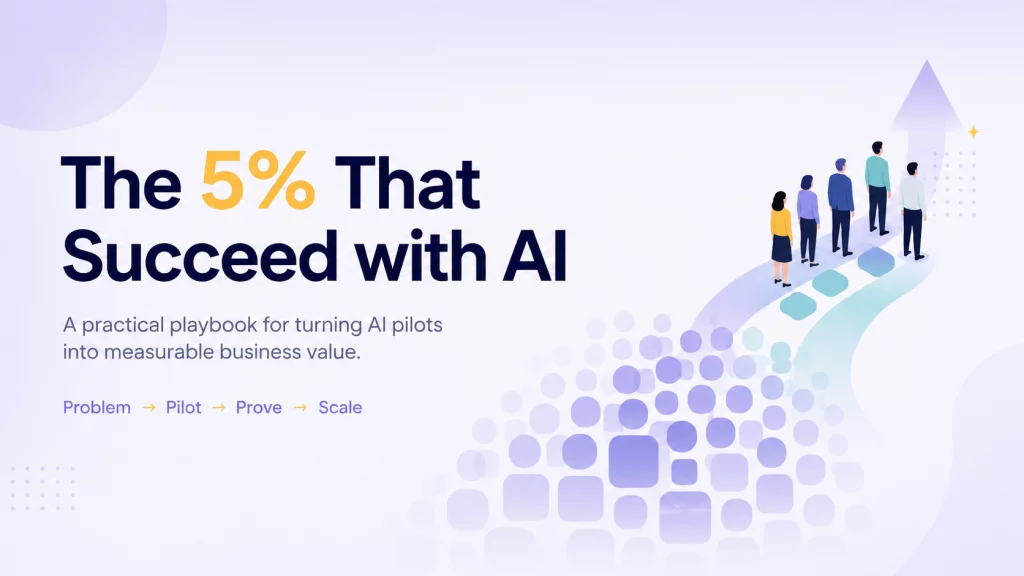
95% of AI pilots fail. MIT studied 300+ deployments. Billions spent. Barely any ROI.
But here’s what nobody talks about: it’s not the technology. Every executive team asks the same question after their pilot stalls: “Why didn’t this work? The AI is incredible.”
Answer: Because they treated AI like a feature you bolt onto a broken process. It’s not.
From talking with dozens of enterprise teams, the ones that actually succeed (the 5%) do something different from day one.
How the 5% Think Differently
They don’t ask: “How do we use AI?”
They ask: “What’s actually costing us money?”
One customer came to us saying: “Our planning takes three weeks. We’re drowning in scope documents, manually extracting features, estimating, risk-gathering. It’s killing us.”
That’s an actual problem. Not “let’s try AI on something.”
They ran a three-month pilot. AI read their scope documents and auto-generated 80% of the planning artifacts (user stories, features, risks, tasks). The team reviewed and refined the last 20%. Planning time dropped from three weeks to five days.
Simple. Measurable. Real money saved.
That’s how you end up in the 5%.
Why the 95% Stall (The Pattern)
Wrong problem. They pick what sounds cool, not what costs money. (“Let’s allow customers to chat with our menu.”) Six months later, no one uses it. It gets killed.
Too many cooks. The pilot touches six teams, requires data from five systems, needs approval from four stakeholders. Bottleneck. Stall.
Vague success. Nobody agreed upfront what “success” looks like. Marketing expects 60% automation. Dev expects 20%. Leadership expects it to be free. Pilot ends. Everyone’s disappointed.
Skipped the data audit. Halfway in, they realize the data they’re feeding the AI is incomplete, inaccurate, or disconnected. The AI does its best with garbage. They blame the AI.
Too much, too fast. They build the Taj Mahal on day one. Expect 100% accuracy immediately. Go straight to full automation. First failure gets amplified across the organization. AI credibility dies.
No plan for production. Pilot succeeds. Now what? Compliance questions. Security gaps. Training gaps. They discover all this after the pilot works, not before. Project gets stuck.
The Framework That Works
Pick a real, painful problem. Run a tight three-month pilot. Follow this:
Month 1: Humans review 100% of AI outputs. You’re building confidence and catching failures early.
Month 2-3: AI handles low-risk decisions. Humans review high-stakes ones. You prove value incrementally.
Alongside: Plan your production infrastructure. Get compliance. Train the team. Don’t get surprised.
At the end: Either you scale it or you learned enough to kill it fast. Either way, you didn’t waste a year.
Four Things That Actually Work
Our customers are using AI in four concrete ways in project delivery:
- Scope → Plan (minutes, not weeks) Upload an RFP or requirements document. AI generates work items, user stories, features, identified risks. You review and refine. Planning that took three weeks now takes three hours. Most organizations leave 80% as-is. It’s good enough.
- Skeleton → Spec You have a user story title. AI fills in the full description, acceptance criteria, test cases, implementation subtasks. Dev and QA have clear, complete specs. No ambiguity. Handoffs are faster.
- Recognize Patterns AI matches your current work to similar things your organization has done before. Pulls the docs, code, lessons learned. Your team learns from what worked (or didn’t). Solutions improve over time.
- Health at a Glance Executives want to know project status. Instead of a three-hour meeting, AI reads the metrics, sentiment data, and conversations. Outputs: Here’s what’s healthy, here’s what’s at risk, here’s what to do. Real insights in minutes.
All of this lives inside Nimble. Your data never leaves. You pick your AI model. It adapts to how you work.
What Kills It (Actual Mistakes)
- Chasing cool instead of impactful. “Let’s try AI on our blog.” Nobody cares. Kill it.
- Six teams involved. Too many stakeholders means nothing moves. Keep pilots to 1-3 teams.
- “Success” is undefined. You failed already. Define it before day one.
- Garbage data. You have legacy systems with incomplete or wrong data. Audit before you start.
- Going all-in immediately. Expecting perfect automation on day one. Use human-in-the-loop. Build confidence.
- Public AI for confidential data. ChatGPT trained on your customer data. Use bring-your-own-LLM or private deployments.
The Organization Question
Here’s what confuses most companies: Who owns AI?
Wrong answers:
- IT owns it all. (Business units don’t move because they don’t own the problem.)
- Business units own it all. (Security, compliance, cost control nightmare.)
- CEO owns it. (Too slow, other stuff takes priority.)
Right answer:
- IT owns the infrastructure (data pipeline, model deployment, security, compliance, APIs).
- Business units own the problems (what to solve, domain logic, budget, timeline).
- IT builds the highway. Business units drive different vehicles. IT ensures safety. Business units decide where to go.
- This takes leadership clarity to set up. But it’s the only structure that scales.
What Matters Now (Skills)
AI doesn’t replace your PM team. It changes what they do.
Skills that matter more: Domain expertise, communication, understanding real workflows, managing change.
Skills that matter less: Manual Gantt chart building, chasing down status updates, administrative formatting.
The teams that move fastest add 2-3 AI-native people (who understand agentic systems and LLMs) but keep the domain experts. That’s where the value actually lives.
If you try to do this with only engineers or only with domain experts, you fail. You need both.
Getting to Production (The Real Blocker)
Most pilots succeed. Then they stall because nobody planned for production.
While you’re piloting, start the production work in parallel:
- Infrastructure requirements (compute, storage, API access)
- Compliance and legal sign-off (data usage, model governance, liability)
- Security audit (data protection, model monitoring, rollback plans)
- Training plan (how your team actually uses this at scale)
This isn’t after the pilot works. This is concurrent. Otherwise, you’ll finish the pilot and spend six months trying to get legal approval.
The One Question to Ask
Before you start: What’s the actual cost of the current state?
Three-week planning cycles cost you a month of lost time per project. Unclear specs cause rework. Manual status reporting takes 20 hours a month per PMO person.
Put a number on it. Show executives what you’re spending on the broken process.
Then: “If we could cut planning time by 80%, what would that be worth?”
That’s your business case. That’s what separates success from “neat tech project that goes nowhere.”
Bottom Line
The 95% that fail treat AI like magic that fixes broken processes. The 5% that succeed treat it like a tool to fix something specific that’s costing them real money. Start there. Everything else follows.
For your next project: Pick the painful problem. Audit the data. Define success upfront. Run a tight pilot. Plan production in parallel. Use human-in-the-loop. Measure the money saved.
Do that, and you’re already ahead of 95% of companies trying this.
Ready to scale? Teams running this playbook are using Nimble to bring scope-to-plan, pattern recognition, and health checks together—where your team reviews, refines, and improves over time. Your data stays protected. Your choice of model. No forced automation.
Sources & Further Viewing: The insights, examples, and implementation lessons in this guide are drawn from our three-part AI in Project Delivery webinar series:
- Webinar 1: AI in Project Delivery: Four Practical Applications You Can Use Today
- See the real-world applications that are already working. Scope prediction, burnout detection, approval acceleration, and decision intelligence—what they are, how they work, and how to start using them this week.
- Webinar 2: Why Most AI Projects Fail – And How to Make Yours Succeed
- Learn why 95% of AI initiatives underdeliver and exactly what the winning 5% do differently. The patterns, the structure, the guardrails—everything you need to avoid the failure traps.
- Webinar 3: AI in Project Delivery: Implementation & Live Demo
- Watch it work. See the framework in action. Live walkthrough of how the four applications integrate, how governance works in practice, and how to pilot this in your org.