


9 best enterprise PPM software for hybrid teams
These PPM software are grouped by what each tool is really built for.
Core Enterprise PPM/SPM
- Planview
- NimbleWork
- Broadcom Clarity
- Planisware
- ServiceNow SPM
- Triskell
Enterprise planning and work management alternatives
- Atlassian Align
- Wrike
- Businessmap
1. Planview
A good choice for centralized enterprise portfolio governance.
Planview gives large organizations a portfolio layer above mixed delivery teams and toolchains. Its strategic portfolio management offering connects strategy, objectives, investments, capacity, finances, roadmaps, and execution data, while teams can continue to work in Agile, predictive, or hybrid models.
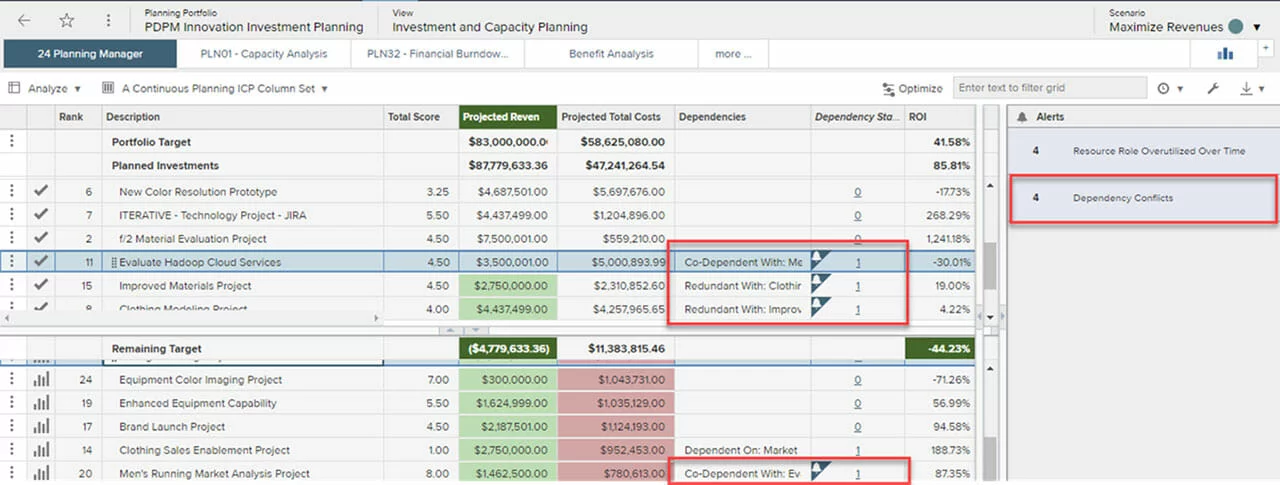

Scenario planning, demand management, investment prioritization, resource planning, and portfolio reporting make it well suited to executives and PMOs that need to decide what to fund.
Planview also promotes more than 60 integrations, including Jira, Azure DevOps, GitHub, and ERP systems, though the exact workflow may span Planview Portfolios, AdaptiveWork, AgilePlace, Hub, or other products in the suite.
Best for: Large, governance-heavy enterprises that need one investment and capacity view across business units, delivery methods, and execution tools.
Trade-offs: Planview’s breadth is also its main buying risk. “Planview” is a product family, so buyers must map every requirement to a named product, module, integration, and license before comparing proposals. Expect more design, administration, and change-management work than with a lighter work-management platform.
Third-party reviews: Planview’s portfolio reviews are based mostly on its portfolio-wide visibility, investment and capacity planning, scenario modeling, customizable dashboards, and ability to act as a central system of record for strategy and execution.
But, the recurring trade-off is usability. The users describe the interface as dated or spreadsheet-heavy, with deep menus, a steep learning curve, and significant setup for roles, permissions, imports, and integrations. Some also report sluggishness with large datasets or long work breakdown structures.
Overall, the reviews portray Planview as powerful for organizations willing to invest in administration and adoption; but not as a lightweight tool.
Pricing: Quote-only. Ask for a full cost model that includes the portfolio product, execution products, integration layer, implementation, environments, training, and premium support.
2. NimbleWork
The best choice for enterprise PPM software with AI that you’re looking out for.
NimbleWork is an enterprise PPM software designed for large enterprises managing complex portfolios across business units, geographies, and delivery models. It’s absolutely suitable for organizations that do not want separate systems for Scrum teams, Kanban teams, and plan-driven projects too.
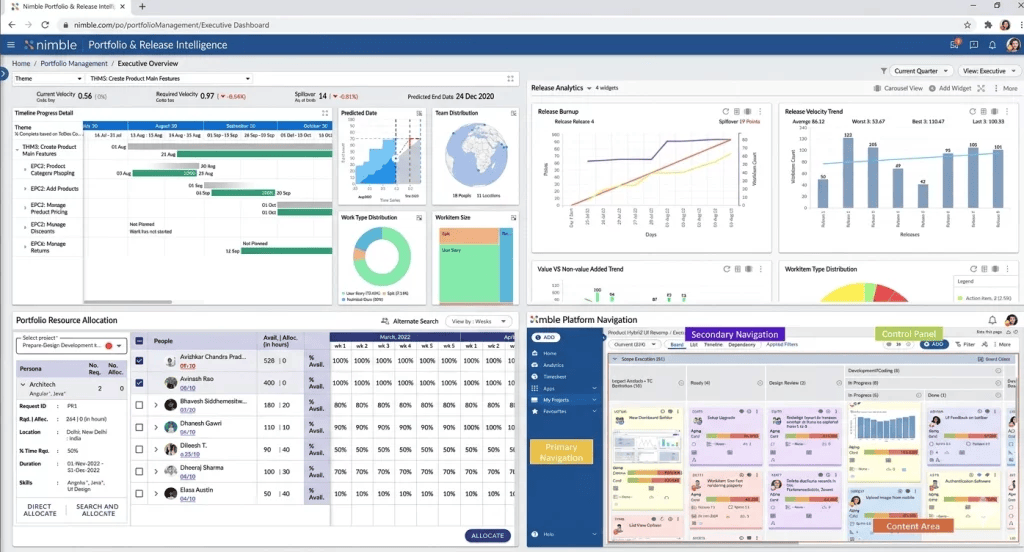

Its portfolio layer brings demand, prioritization, budgets, people, capacity gaps, and portfolio analytics into a common governance environment, giving executives and PMOs visibility into where investment and resources are committed. This combination is compelling for transformation programs where one initiative may include sprint-based product work, fixed-date implementation milestones, and portfolio-level funding controls.
The same platform supports Waterfall, Scrum, Kanban, and hybrid execution through Gantt planning, dependencies, constraints, critical-path controls, and hybrid tasks that connect iterative work to predictive plans. This allows leaders to govern funding, capacity, dependencies, and delivery centrally without forcing every team into the same methodology.
NimbleWork is a powerful contender when it comes to evaluating some of the best PPM tools. With its AI agents embedded in the workflows, the tool provides the exact delivery intelligence that you need.
Best for: Large enterprises and mid-sized organizations that want Agile and traditional delivery teams working in one configurable environment, without imposing one method on every team.
Trade-offs: The portfolio capabilities relevant to a large-enterprise evaluation sit primarily in the Enterprise tier, so the public Team and Business prices are not a useful proxy for the final PPM cost. Nimble’s main disadvantage against better-known incumbents is market visibility: it has a smaller public review footprint and may be less familiar to buying committees, even when it is competing for the same enterprise use cases.
Third-party reviews: In their reviews, NimbleWork’s users describe it as easy to learn and useful for coordinating teams, tracking work and issues, and keeping task progress visible. Implementation and day-to-day task management also receive favorable comments.
Criticism is narrower but consistent: some users want stronger reporting and data-extraction options, particularly for analyzing tracked work in Excel-style formats. The feedback is encouraging for teams that value straightforward work coordination.
Pricing: 1-month free trail. Post the trial period, ‘Team’ costs $10 per user per month for up to 50 users, while Business costs $26 per user per month for up to 200 users. Enterprise, intended for more than 200 users and advanced portfolio governance, is quote-only. NimbleWork lists annual billing and a one-month free trial.
3. Broadcom Clarity
Built for investment, financial, and resource planning at enterprise scale
Broadcom Clarity is strongest when the portfolio conversation starts with money, people, and strategic investment choices. It brings investments, projects, products, roadmaps, budgets, resources, and outcomes into a common strategic portfolio model, giving executives a clearer view of where capacity and funding are committed.
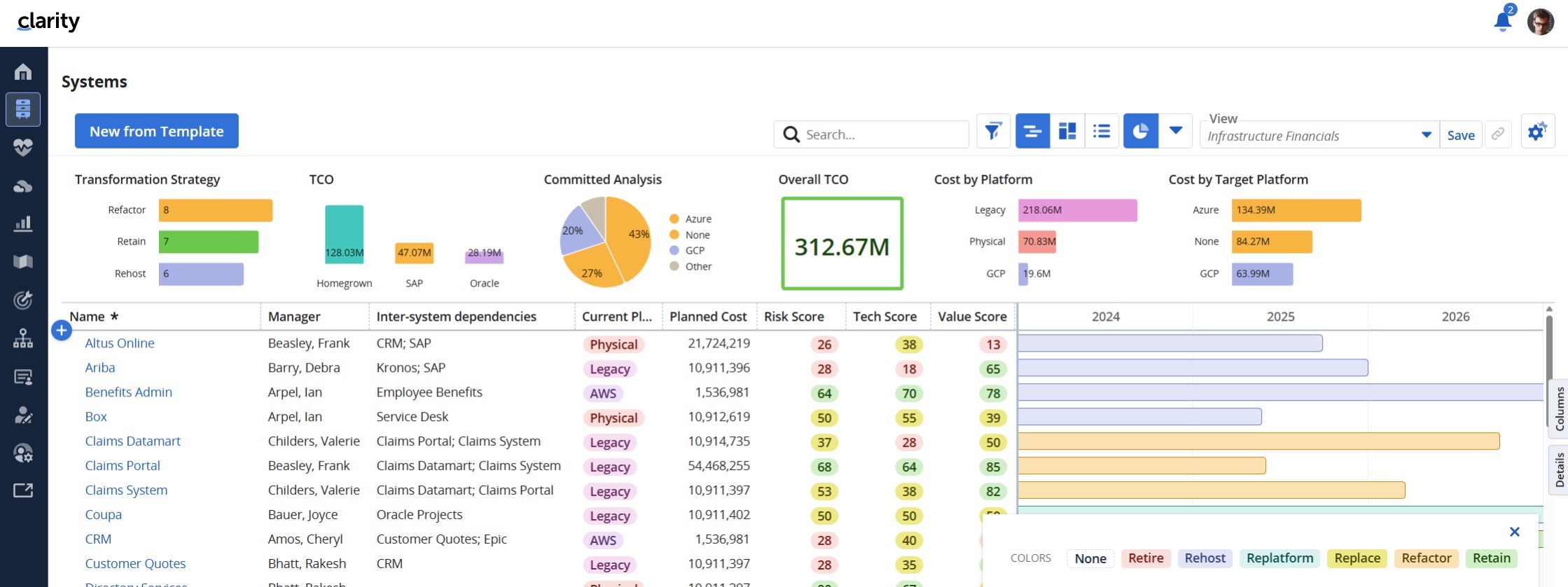

It can support mixed delivery methods, but Agile execution is often connected through Broadcom’s wider ValueOps environment, including Rally and ConnectALL, rather than managed solely inside Clarity.
That architecture works well for enterprises that want a strong financial and governance core while allowing delivery teams to keep specialist tools.
Best for: Large enterprises that prioritize strategic investment planning, financial control, resource capacity, and executive roadmaps over team-level task management.
Trade-offs: Clarity is not a plug-and-play work tracker. Configuration, data governance, operating-model design, and implementation services can be substantial. Buyers also need to define whether Rally, ConnectALL, or other ValueOps components are required to support their Agile teams and integrations.
Third-party reviews: Across the reviews, users value its depth in portfolio, financial, resource, and investment management, along with reporting and customization that support strategic planning at enterprise scale.
The most common complaints concern a steep learning curve, a complex or dated interface, slow interactions, and the amount of expertise required to configure workflows and reports. Some reviewers also want easier customization and more detailed resource-planning capabilities.
The consensus is that Clarity can provide strong governance and decision support, but the payoff depends on disciplined implementation, capable administrators, and user training.
Pricing: Quote-only and custom. Request separate prices for Clarity, any ValueOps products, non-production environments, connectors, implementation, data migration, and ongoing platform administration.
4. Planisware
The specialist choice for R&D, new product development, and stage-gate portfolios.
Planisware Enterprise combines executive portfolio selection with detailed program and project controls. Its portfolio capabilities include roadmaps, business-case scoring, budget and resource constraints, scenario comparison, NPV and expected commercial value analysis, and efficient-frontier techniques.
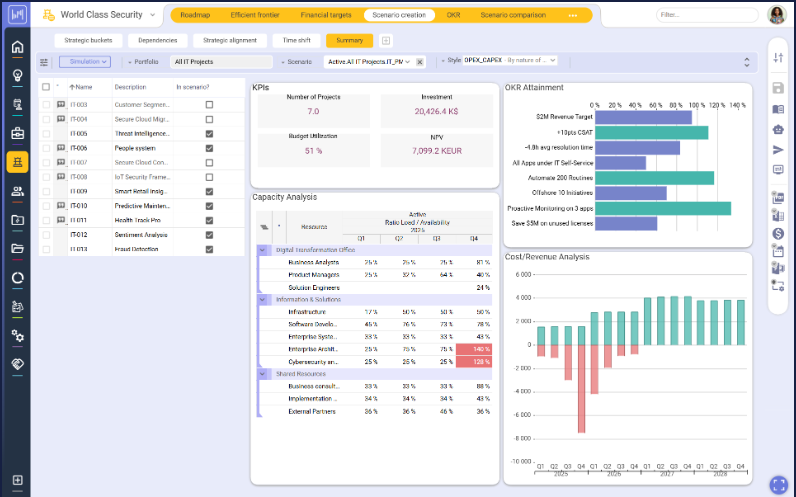

Below that layer, teams can use advanced Gantt, PERT, work breakdown structures, earned value management, Scrum, Kanban, SAFe, and Stage-Gate controls. This breadth is especially valuable in pharmaceuticals, aerospace, manufacturing, chemicals, and other R&D environments where experiments and Agile teams still need to pass investment gates and share scarce specialists.
Best for: Large R&D, engineering, innovation, and new-product-development portfolios with complex resources, financial models, dependencies, and formal gates.
Trade-offs: Planisware can be configured deeply, but too much customization raises testing and upgrade costs. ADNOC’s published case study says extensive customization created complexity and a significant testing burden, which led the company back toward standard features. That is a useful warning for any buyer tempted to reproduce every legacy process in the new platform.
Third party reviews: The users are positive about its scenario modeling, simulations, portfolio comparisons, funding allocation, and ability to replace disconnected spreadsheets with a governed hub for projects, resources, and financials. Its industry-specific depth is frequently valued in R&D, innovation, and regulated product-development environments.
The downside is the weight that comes with that depth: reviewers mention substantial initial setup, an enterprise-style interface, significant training needs, reports that can be difficult to digest, and gaps in historical record keeping.
In short, users see Planisware as highly capable for complex portfolios, but rarely as quick or simple to deploy.
Pricing: Quote-only. Cost depends on modules, user roles, deployment scope, integrations, implementation, and the amount of configuration. Ask the vendor to separate standard functionality from custom work in the proposal.
Related reading: 9 Best Enterprise PMO Software for Complex Projects and Cross-Functional Delivery
5. ServiceNow SPM
It makes the most sense when ServiceNow is already a strategic platform.
ServiceNow Strategic Portfolio Management (SPM) connects strategic planning, demand, roadmaps, project portfolio management, resources, and execution within the Now Platform. It supports work delivered through Waterfall, Agile, or hybrid methods and can connect to Microsoft Project, Jira, and Azure DevOps, giving portfolio leaders a common view while teams retain familiar delivery tools.
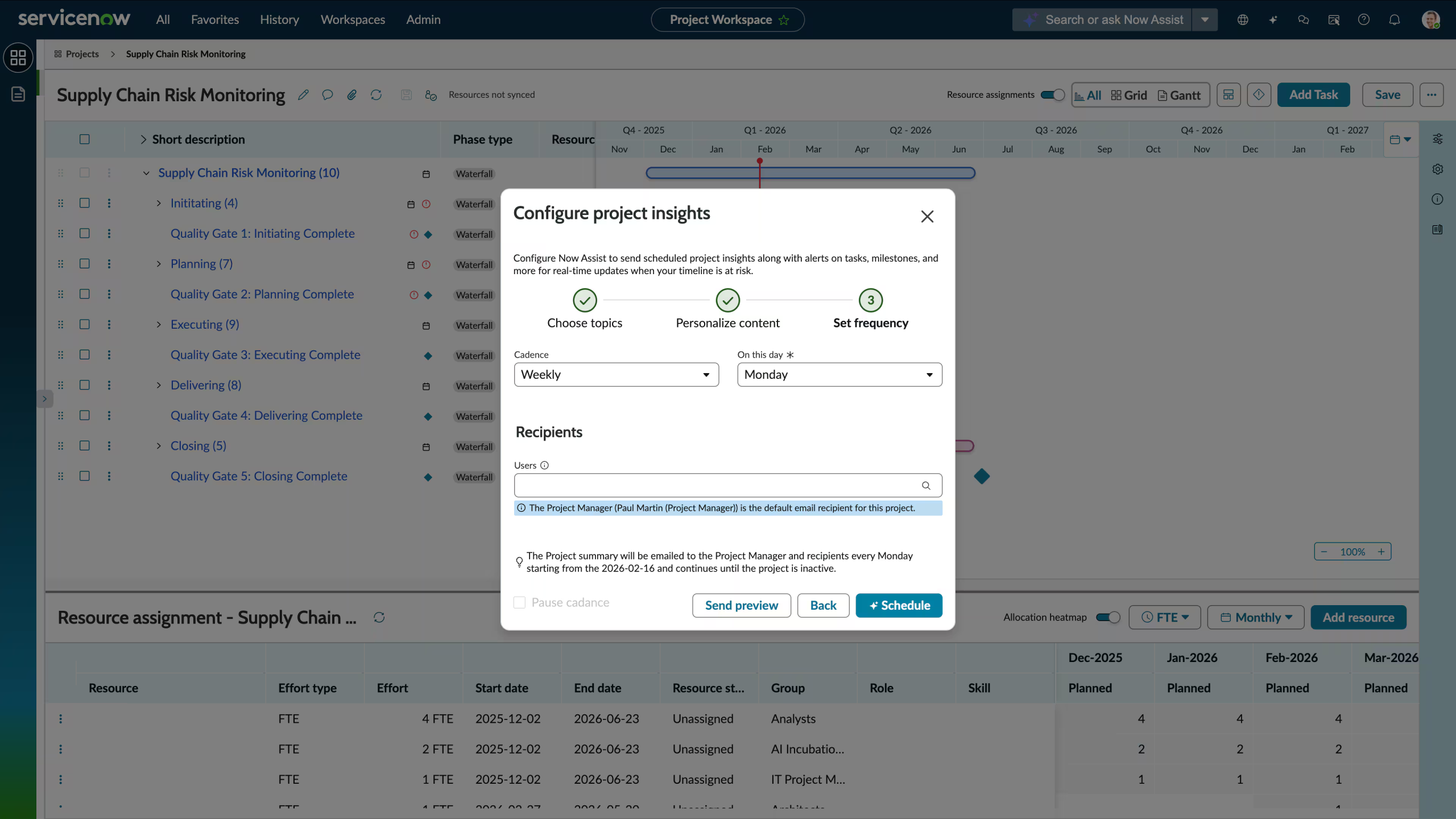

Its biggest advantage is context: organizations already using ServiceNow for IT, workflows, assets, operations, or customer processes can connect portfolio choices to operational data and governed workflows.
Best for: Enterprises already in the ServiceNow ecosystem that want portfolio planning tied to demand, operational workflows, and a shared data model.
Trade-offs: SPM can be an expensive and administration-heavy choice if ServiceNow is not already established. Capabilities may depend on licensed applications, plugins, integrations, and configuration, so buyers should insist on a requirement-to-SKU matrix. A technically successful rollout can still fail if the company uses SPM only as a project register instead of changing investment decisions.
Third-party reviews: Reviewers like having strategy, projects, priorities, progress, and portfolio reporting in one environment, saying the resulting visibility helps teams stay organized and make better prioritization decisions. The fit is particularly strong when an organization already uses the ServiceNow platform.
Negative feedback centers on the breadth and complexity of the product: the learning curve is steep, the interface is not always intuitive, configuration can require experienced administrators, and platform cost is a recurring concern.
The review pattern suggests strong enterprise coordination value, provided the buyer can absorb the implementation and governance overhead.
Pricing: Quote-only. ServiceNow directs buyers to request pricing, and an SPM license is required. Include platform prerequisites, SPM applications, integration costs, implementation, test instances, and ongoing administration when estimating total cost.
6. Triskell
The flexible EPPM option for organizations with distinctive governance models.
Triskell focuses on configurable enterprise portfolio management and strategy execution. It can connect strategy, initiatives, budgets, costs, resources, capacity, and delivery progress while accommodating Agile, Waterfall, phase-gate, or organization-specific lifecycles. 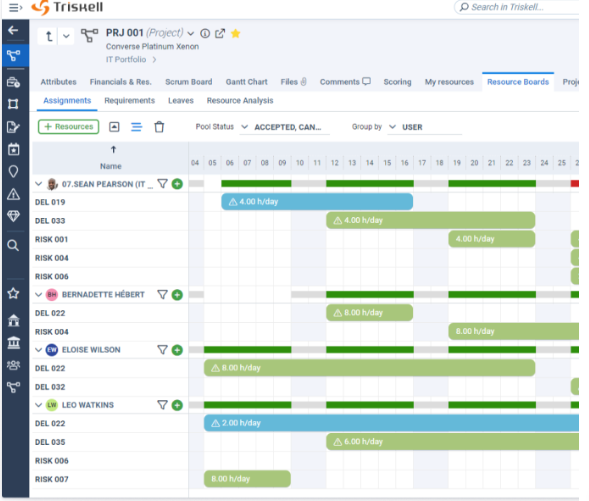

Its integration catalog includes Jira, Azure DevOps, SAP, Power BI, and SharePoint, which lets teams keep execution tools while portfolio leaders consolidate plans and performance. This is attractive to organizations whose governance model does not fit neatly into a larger vendor’s standard template.
Best for: Organizations that want a configurable EPPM and strategy layer without buying one of the largest enterprise suites.
Trade-offs: Flexibility creates design responsibility. The customer must make clear decisions about taxonomy, approvals, measures, ownership, and reporting or the platform can become inconsistent. Triskell also has a smaller partner ecosystem and lower public review volume than the best-known vendors, so buyers should test API depth, reporting scale, regional support, and upgrade practices.
Third-party reviews: Triskell’s reviewers praise its adaptability, configurable screens and workflows, data security, portfolio and calendar visibility, and support for structured approval processes; several comments suggest it is a practical step up from large, unstable spreadsheets.
The main caution is configuration governance: access rights and permissions need to be designed carefully at the outset and can be awkward to revise later. Some feedback also frames the product as straightforward for basic project-management needs, implying that organizations pursuing a complex EPPM design should expect more deliberate setup.
Pricing: Quote-only and custom. Ask for named versus occasional-user licensing, portfolio and strategy modules, connectors, sandboxes, implementation, and support in the same commercial response
7. Jira Align
The clearest choice for Agile-at-scale strategy alignment.
Jira Align connects strategic themes and investment choices to programs, epics, features, dependencies, delivery progress, and financial health.
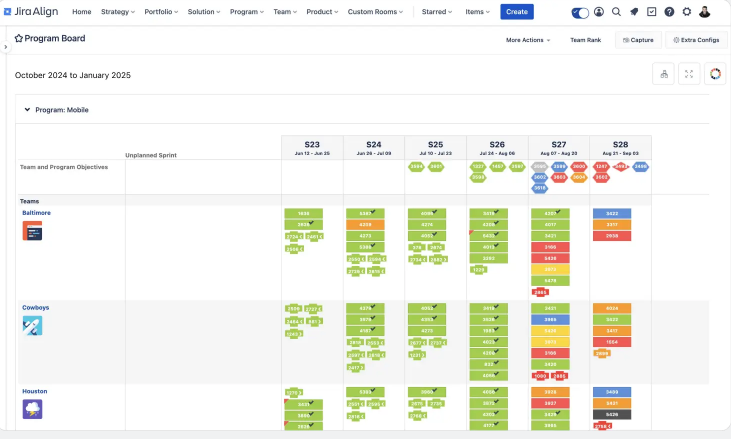

It supports several scaled-Agile frameworks and also permits custom or hybrid Agile–Waterfall operating models. Its natural advantage is connecting enterprise planning to delivery data from Jira, while Azure DevOps integration is also supported.
Align is built for strategy-to-execution visibility across product and technology portfolios; it is not a specialist tool for critical-path scheduling, engineering controls, or detailed stage-gate R&D management.
Best for: Agile-heavy enterprises that need executive portfolio alignment across many teams, programs, products, and value streams.
Trade-offs: The buying threshold is high. Align is sold as part of Atlassian’s Strategy Collection, not as a standalone product, and Jira Cloud Premium is a prerequisite. The collection is cloud-only, has no free trial, and some analytics capabilities require Jira Cloud Enterprise. Organizations seeking classic PPM depth may also need another system for detailed cost, resource, or CPM scheduling.
Third-party reviews: Jira Align’s customizable views, strategy-to-execution traceability, program and portfolio visibility, dependency tracking, and the ability to support data-driven decisions across many Agile teams is repeatedly valued by the users.
The recurring criticism is that gaining this visibility can add governance effort: some users report a rigid delivery experience, increased administrative overhead, integration or performance issues, and navigation complexity.
The overall picture is favorable for enterprises that prioritize cross-team alignment, but less compelling for teams that expect the portfolio layer to feel as lightweight as their delivery boards
Pricing: Atlassian lists the Strategy Collection at $77,400 per year for 1–50 users. It includes Focus, Talent, and Align, is billed annually, and requires Jira Cloud Premium; larger bands go through enterprise sales.
8. Wrike
The practical option for cross-functional work with lighter PPM requirements.
Wrike combines boards, lists, Gantt charts, dependencies, request forms, configurable workflows, dashboards, and portfolio reporting in a platform that business and technical teams can share.
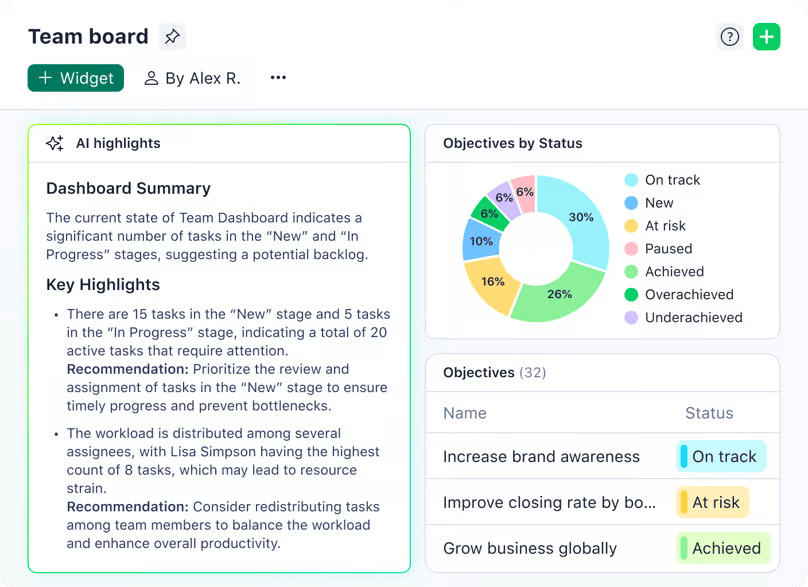

Higher tiers add resource and capacity planning, budgeting, advanced reporting, business intelligence, and broader integration controls. That makes Wrike a good fit when marketing, operations, professional services, product, and IT need common planning without the weight of a governance-first PPM suite.
It can support hybrid delivery well, but it is better viewed as enterprise work management with portfolio features than as a full replacement for Planview, Clarity, or Planisware in complex financial and engineering environments.
Best for: Cross-functional enterprises that need fast adoption, flexible workflows, and useful portfolio visibility but do not require the deepest investment, stage-gate, or resource-governance controls.
Trade-offs: The features most relevant to enterprise PPM—advanced capacity planning, portfolio budgets, advanced analytics, and expanded integrations—sit in the quote-only Pinnacle and Apex tiers. Wrike’s flexibility can also produce inconsistent folders, statuses, and reports unless administrators set a clear information model. Complex scenario planning, investment optimization, and formal financial governance are not its strongest areas.
Third-party reviews: The reviewers consistently praise Wrike’s flexible workflows, dashboards, task ownership, templates, request forms, integrations, and ability to centralize communication and project information for distributed teams.
Its customization and collaboration features are the clearest strengths, but they also create friction: common complaints include a steep learning curve, a cluttered or unintuitive interface, complex configuration, excessive notifications, and missing or restricted features on lower tiers.
Some users also mention weaker mobile or offline experiences, slower performance on large workspaces, and rising costs as more seats or premium capabilities are added.
Pricing: Free is $0; Team is $10 per user per month for 2–15 users; Business is $25 per user per month for 5–200 users, with annual billing. Pinnacle and Apex are quote-only, and those are the tiers most relevant to advanced PPM evaluation.
9. Businessmap
The choice for connecting strategy to execution across hybrid portfolios.
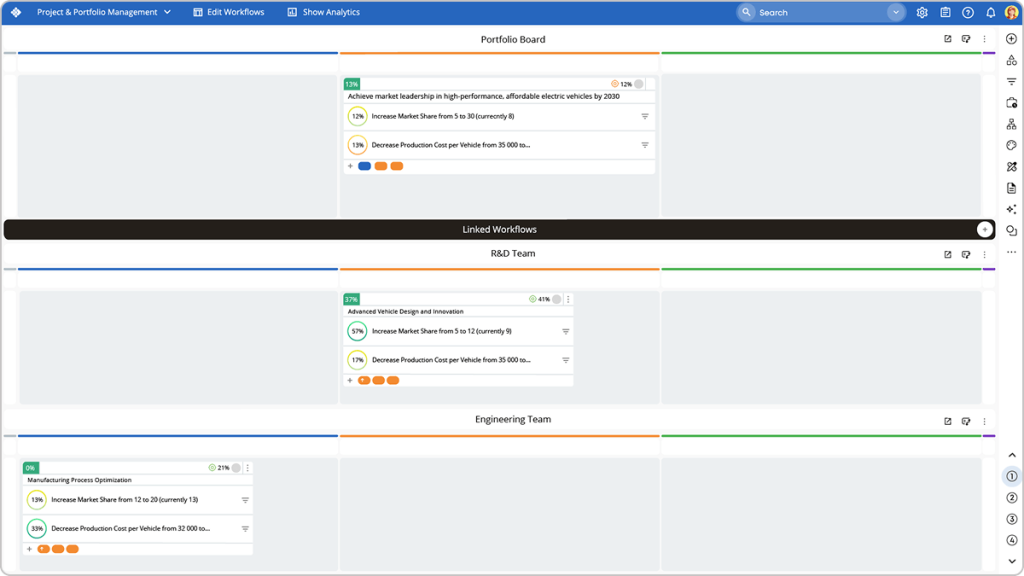

Businessmap connects strategic objectives, portfolio initiatives, and day-to-day execution work in one environment, helping leaders see how work progresses and how it contributes to business goals. Its portfolio workspaces provide visibility into initiatives, project progress, and cross-team dependencies, while teams can manage delivery through flexible workflows that support Lean, Agile, and hybrid approaches.
It brings strategic planning and execution together through its AI Canvas. Teams can visualize strategies, brainstorm initiatives, import documents, and get insights based on the context of the work.
Best for: Mid-sized and large organizations that need portfolio-wide visibility, cross-team coordination, and a clear connection between strategic goals and operational execution.
Trade-offs: Businessmap offers a broad set of portfolio, workflow, analytics, and AI capabilities, so organizations may need time to configure workflows and establish consistent governance practices.
Third-party reviews: Users praise its flexible workflows, intuitive visual boards, portfolio visibility, and advanced analytics. Reviewers appreciate how the platform helps teams improve collaboration, identify bottlenecks, and monitor work across projects. Customer support and customization are also frequently highlighted. On the downside, some users note a learning curve due to the extensive feature set.
Pricing: Standard plan with published seat-based pricing and an Enterprise plan with custom pricing. The Standard plan includes the core platform capabilities, while Enterprise offers additional options for organizations with broader security, support, and deployment requirements.