


Every successful project starts with a clear vision and a solid plan, which is crucial when scaling small businesses. At the heart of this plan lies the project scope – a powerful tool that sets the stage for everything that follows. But what exactly is project scope, and why is it so important?
Think of project scope as the blueprint for your project. It outlines what you’re going to do, how you’re going to do it, and what the end result should look like. Whether you’re a seasoned project manager or just starting out, understanding project scope is key to bringing your ideas to life. In this article, we’ll dive into project scope, exploring what it means, why it matters, and how to get it right. So, let’s roll up our sleeves and get started!
What is Project Scope?
Project scope is a comprehensive outline of all work required to successfully complete a project. It encompasses the project’s objectives, deliverables, tasks, resources, timeline, and any constraints or assumptions. By clearly defining what is included and excluded from the project, scope establishes the parameters within which the project team will operate. This clarity is crucial for aligning stakeholder expectations, managing resources effectively, and mitigating potential risks.
A well-defined scope acts as a roadmap for the project, guiding decision-making and providing a benchmark for measuring progress. Without it, projects can easily veer off course, leading to scope creep, budget overruns, and missed deadlines. Proper scoping is therefore essential for successful project execution, ensuring that all team members and stakeholders have a shared understanding of the project’s boundaries and goals. It forms the foundation upon which all other project management processes are built, ultimately contributing to the efficient and effective achievement of project objectives.


Src: aboutcivil.org
The Importance of Defining Project Scope
Defining project scope is a critical step that should not be overlooked. A clearly defined scope provides numerous benefits, including:
☑ Aligning Stakeholder Expectations: By clearly outlining the project’s objectives and deliverables, stakeholders have a shared understanding of what the project aims to achieve, minimizing misunderstandings and conflicts.
☑ Effective Resource Allocation: With a well-defined scope, project managers can accurately estimate the resources required, including personnel, materials, and budgets, ensuring optimal resource utilization.
☑ Risk Mitigation: By establishing project boundaries and constraints, potential risks can be identified and mitigated proactively, reducing the likelihood of project delays or failures.
☑ Improved Decision-Making: With a clear understanding of the project scope, project managers and stakeholders can make informed decisions regarding changes, trade-offs, and prioritization.


Failing to define project scope adequately can lead to numerous challenges, such as scope creep, unclear expectations, resource mismanagement, and increased project costs and delays.
Why Scope Management Matters: The Real Cost
Scope issues don’t break projects overnight.
They show up as small, reasonable decisions:
- adding a quick feature
- adjusting a requirement
- approving a change informally
And then they compound.
A team starts building the wrong thing because the objective wasn’t clear enough. Stakeholders keep adding “small” requests because nothing defines what’s out of scope. Changes get approved in conversations, but never recorded. One missed dependency delays multiple workstreams.
And over time, no one can clearly tell what actually changed from the original plan. Individually, these feel manageable. But together, they create a very specific kind of failure:
- work that has to be redone
- timelines that quietly slip
- budgets that stretch without visibility
- teams that are busy — but not aligned
The bigger problem is not operational. It’s strategic. When scope isn’t actively controlled:
- projects drift away from their original goals
- delivery becomes unpredictable
- and stakeholders lose confidence in the outcome
At that point, the question is no longer: “Did we define the scope correctly?”
It becomes:
“Do we have any reliable way to track what we’re actually delivering?”
That’s the real cost of poor scope management.
Not confusion at the start — but loss of control during execution.
Components of Project Scope
A comprehensive project scope should include the following components:
☑ Project Objectives: The specific goals and desired outcomes of the project.
☑ Deliverables: The tangible or intangible products, services, or results that will be delivered upon project completion.
☑ Milestones: Key checkpoints or achievements that mark significant progress or completion of project phases.
☑ Tasks: The specific activities and work packages required to complete the project.
☑ Costs: The estimated budget and financial resources needed for the project.
☑ Deadlines: The target start and end dates for the project and its various phases or milestones.
How to define Project Scope in 8 steps?
Defining project scope is a multi-step process that involves collaboration with stakeholders and a thorough understanding of project requirements.
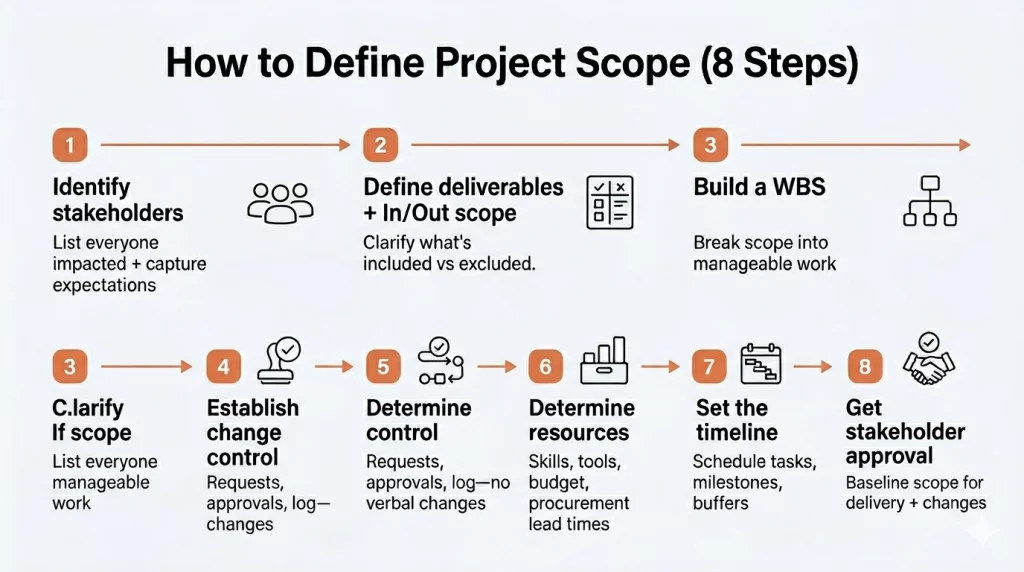

Here’s an elaboration on each of the 8 steps for Project Scope Management:
Step 1: Identify stakeholders and understand their expectations
This crucial first step involves creating a comprehensive list of all parties involved in or affected by the project. This includes not just the obvious players like clients and team members, but also end-users, regulatory bodies, and even competitors in some cases. Once identified, engage with these stakeholders through interviews, surveys, or workshops to gather their expectations, requirements, and any constraints they foresee.
This process helps in creating a holistic view of what the project needs to achieve and the potential challenges it might face. Remember, stakeholders’ expectations can sometimes conflict, so it’s important to document and prioritize these expectations carefully.
Step 2: Define SMART project objectives
In this step, you distill the information gathered from stakeholders into clear, concise, and measurable objectives. These objectives should answer fundamental questions about the project’s purpose and intended outcomes. Use the SMART criteria (Specific, Measurable, Achievable, Relevant, Time-bound) to frame these objectives. For example, instead of a vague objective like “Improve customer service,” a SMART objective would be “Reduce customer complaint resolution time by 30% within six months of system implementation.” These well-defined objectives will serve as the north star for all project activities and decisions.
| Example: Vague vs. SMART Objective
Vague: Improve customer service SMART: Reduce first-response time from 48 hrs to 8 hrs by Q3 2025, measured via helpdesk ticket timestamps |
Step 3: Define deliverables and the In/Out Scope List
Here, you outline all the specific outputs that the project will produce. These deliverables can be tangible (like a new software application, a physical product, or a report) or intangible (like improved processes or enhanced team capabilities). Be as detailed as possible in describing these deliverables. For a software project, for instance, deliverables might include user interface designs, backend architecture, user manuals, and training materials. Each deliverable should directly contribute to achieving the project objectives defined in Step 2.
Step 4: Build a Work Breakdown Structure (WBS)
This step involves breaking down the project into smaller, manageable chunks of work. Use techniques like the Work Breakdown Structure (WBS) to hierarchically decompose the project into progressively smaller components. Each task should be specific enough that it can be assigned to an individual or team, estimated for time and resources, and tracked for completion. This breakdown not only makes the project more manageable but also helps in identifying dependencies between tasks, which is crucial for project scheduling and risk management.


Nimble’s Gantt chart helps you manage project scope effectively and prevent scope creep.
Step 5: Establish a Change Control Process
Even the best-defined scope will face change requests. Build a formal process before the project starts — not after the first conflict arises.
A minimal change control process includes:
- A standard change request form (who, what, why, impact on time/cost/resources)
- A defined approval authority (who can approve vs. who must escalate)
- A change log visible to all stakeholders
- A rule: no verbal approvals count
Step 6: Determine the resources needed
In this step, you identify all the resources required to complete the project as scoped. This includes human resources (team members with specific skills), material resources (equipment, software licenses, raw materials), and financial resources (budget for different aspects of the project). Be as detailed as possible in your resource planning.
For human resources, consider not just the number of people needed but also the specific skills and experience required. For material resources, consider factors like procurement lead times. This detailed resource planning helps in creating accurate project schedules and budgets.
Step 7: Set the timeline
Based on the tasks identified and resources available, create a realistic timeline for the project. Use techniques like Gantt charts or network diagrams to visualize the project schedule. Identify key milestones and deadlines, ensuring they align with stakeholder expectations and any external constraints.
Consider factors like resource availability, task dependencies, and potential risks when setting timelines. It’s often helpful to build in some buffer time for unforeseen circumstances. Remember, an overly optimistic timeline can lead to project stress and potential failure, while an overly pessimistic one might result in lost opportunities or unnecessary costs.
Step 8: Get approval from stakeholders
The final step is to present the compiled project scope to key stakeholders for review and approval. This typically involves creating a scope statement or project charter document that summarizes all the elements defined in the previous steps. Present this document in a stakeholder meeting, walking through each aspect of the scope.
Address any questions or concerns raised by stakeholders. This step is crucial for ensuring alignment and commitment from all parties. Once approved, this document becomes the baseline against which project progress and changes are measured. Remember, stakeholder approval doesn’t mean the scope is set in stone – it should still be reviewed and potentially updated as the project progresses, but any changes should go through a formal change control process.
Project Scope Statement vs. Project Charter: What’s the Difference?
| Document | Purpose | When Created |
| Project Charter | Authorises the project, names the PM, sets high-level goals | Project initiation |
| Scope Statement | Details exactly what’s in/out of scope, deliverables, constraints | Planning phase |
| Work Breakdown Structure (WBS) | Decomposes scope into manageable tasks | After scope is approved |
| Scope Baseline | Approved version of scope + WBS — used to measure change | After WBS is finalised |
The Role of a Project Scope Statement
A project scope statement is a formal document that captures and communicates the defined project scope to all stakeholders. It serves as a reference point throughout the project’s lifecycle, ensuring that everyone involved has a shared understanding of the project’s objectives, deliverables, and boundaries.
Tips for Defining Project Scope
☑ Involve Stakeholders Early: Engage stakeholders from the outset to gather their input and ensure alignment on project objectives and expectations.
☑ Be Specific and Detailed: Clearly define project objectives, deliverables, tasks, and boundaries, leaving no room for ambiguity or misinterpretation.
☑ Consider Constraints and Assumptions: Identify any constraints, such as budget, resources, or regulatory requirements, as well as any assumptions that may impact the project scope.
☑ Document Everything: Thoroughly document the project scope in a formal scope statement or project charter to ensure clarity and serve as a reference point throughout the project’s lifecycle.
☑ Regularly Review and Update: The project scope is not static; review and update it regularly to reflect any changes or new requirements that may arise during the project’s execution.
Project Scope Management Software Evaluation Checklist
If you’re evaluating tools to support scope management, use this checklist to assess whether a platform can do the job — not just track tasks.
Core Scope Features
- Can you build and manage a WBS natively in the tool?
- Does it support in-scope / out-of-scope documentation linked to deliverables?
- Can you create a scope baseline and track variance against it?
Change Control
- Is there a built-in change request workflow with approval routing?
- Does it log every scope change with timestamp and approver?
- Can you trace approved changes back to the original scope baseline?
Dependency Management
- Can you map cross-task and cross-project dependencies?
- Does the tool alert you when a dependency is at risk?
- Can dependencies be linked to external milestones or teams?
Reporting and Visibility
- Does it offer Gantt, Kanban, and milestone views — not just one?
- Can stakeholders get real-time project status without attending meetings?
- Does it support portfolio-level scope tracking across multiple projects?
Collaboration and Governance
- Can you assign role-based permissions to control who approves scope changes?
- Does it integrate with your existing tools (JIRA, Slack, MS Teams, etc.)?
- Can you attach scope documents, contracts, and sign-off records to the project?
How to check if your tool supports scope management?
Get the free checklist
Pro tip: Use this checklist as a vendor scoring sheet when evaluating project management tools. Score each capability on a 1-3 scale: 1 = Not available, 2 = Partial, 3 = Fully supported. A total below 30 is a warning sign.
How Nimble supports every stage of scope management
Nimble is built for teams that need more than task tracking — it supports the full scope governance lifecycle, from initial definition through change control and reporting.
| Scope Challenge | Nimble Capability |
| Defining and documenting scope | Flexible project setup with scope statements, acceptance criteria, and deliverable tracking |
| Breaking scope into executable work | Native WBS and task hierarchy with multiple views (Gantt, Kanban, List) |
| Preventing scope creep | Scope baseline setting + change request workflows with role-based approval routing |
| Managing cross-project dependencies | Dependency mapping with visual indicators and cascade impact alerts |
| Keeping stakeholders aligned | Real-time dashboards, milestone tracking, and stakeholder-facing project reports |
| Controlling who approves changes | Configurable role-based permissions for change governance |
| Portfolio-level scope visibility | Portfolio management across programs with rollup status and risk indicators |
| Hybrid and agile delivery | Supports Waterfall, Agile, and hybrid methodologies — scope management adapts to your method |
Teams using Nimble reduce scope-related rework by catching changes before they cascade — through structured workflows that make governance a natural part of how work is tracked, not an additional burden.
FAQs
What is the difference between scope management and scope control?
Scope management is the full lifecycle process: planning, defining, validating, and controlling scope. Scope control is specifically the execution-phase activity of monitoring for scope changes and enforcing the change control process. You need both, managing scope without control leads to drift; controlling scope without a management plan means you’re reacting rather than governing.
How do you prevent scope creep without damaging stakeholder relationships?
The key is making the change control process feel collaborative rather than obstructive. Frame it as protecting the stakeholder’s investment: “We can absolutely look at that, let’s run it through our change process so we can assess the impact on the timeline before committing.” Stakeholders who understand the process rarely take it personally.
What should a project scope statement include?
A complete scope statement includes: project objectives (SMART), a full list of deliverables, an explicit in-scope/out-of-scope list, assumptions, constraints, acceptance criteria for each deliverable, and the name of the approving authority. Keep it to 1-2 pages, if it’s longer, it’s a WBS, not a scope statement.
How often should you review project scope?
At minimum, review scope formally at every major milestone and whenever a change request is submitted. On fast-moving projects, a lightweight weekly scope check-in (5 minutes in the status meeting) can catch drift before it compounds. Never go more than 4 weeks without a formal scope review.
Can agile projects have defined scope?
Yes, and they should. Agile projects have flexible scope within a sprint, but the overall product scope (the product goal, release scope, and MVP boundaries) must be defined and governed. Without it, backlogs grow indefinitely. Agile scope management uses techniques like story mapping and release planning instead of a traditional WBS, but the governance intent is identical.
What’s the best way to document scope for a small project?
Even a one-page scope document is better than nothing. Include: what you will build/deliver, what you won’t, the 3-5 key deliverables, and who needs to sign off on changes. A simple shared document with a change log table is sufficient for small projects, the tool matters less than the habit.
Key takeaway
Project scope management is not about saying no, it’s about making every yes a deliberate, documented, and resourced decision. Teams that build strong scope governance early spend less time fighting fires, less time in scope renegotiations, and more time delivering outcomes that actually matter.
Whether you’re running a 3-person internal project or a cross-functional enterprise delivery, the fundamentals are the same: define clearly, baseline formally, change deliberately, and track relentlessly.
NimbleWork gives you the structure to do all four without adding process overhead that slows your team down.