
Overview
Objective and Key Results (OKRs) help define and clarify goals across an organization, department, project, team, or individual. They specify what needs to be achieved to track success by providing measurable indicators.
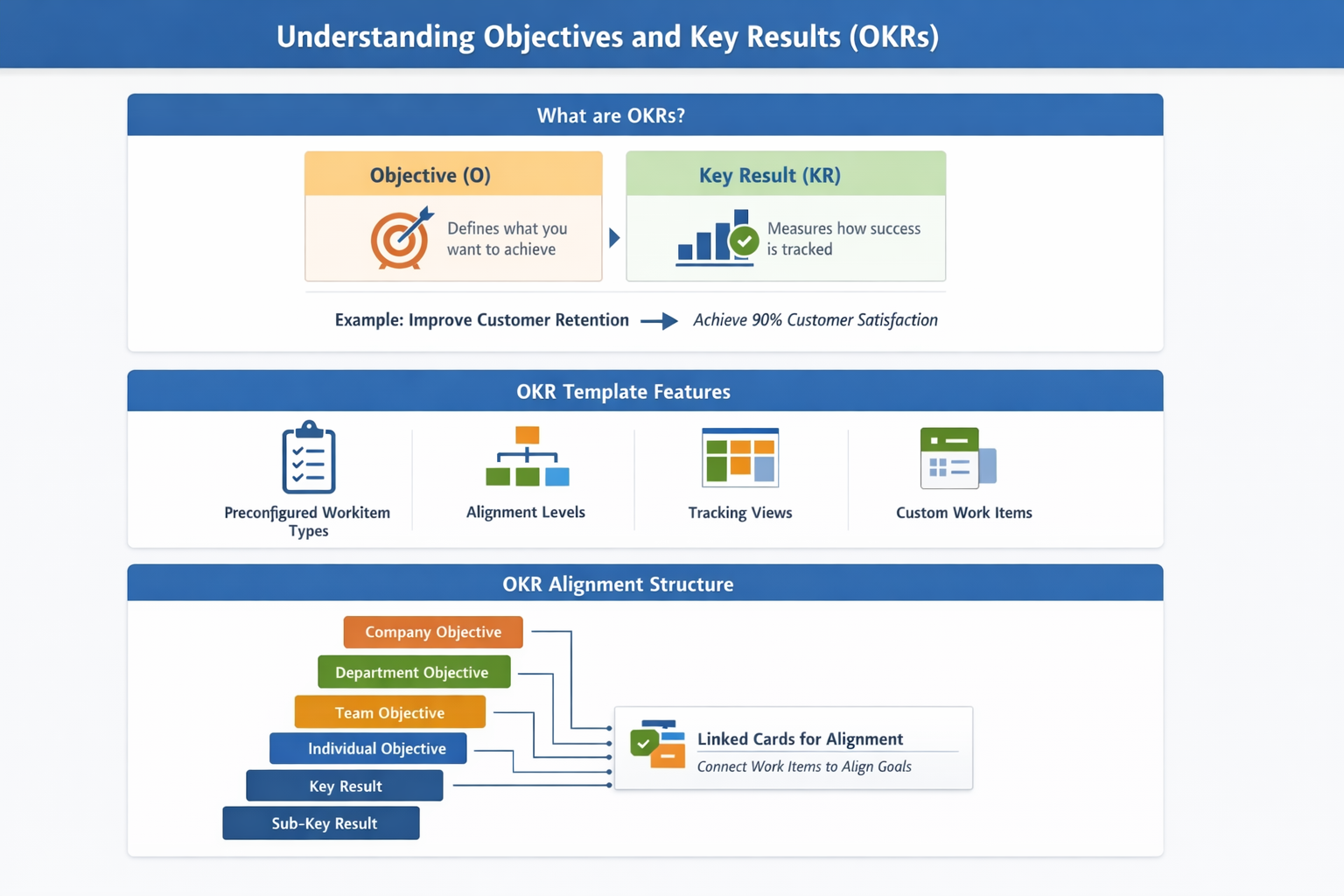
The Objective (O) represent the desired outcome such as improving customer retention or enhancing the employee onboarding process. Key Results (KR) represent measurable outcomes that confirm the objective has been achieved. For example, if your objective is to improve customer retention, then your key result could be achieving a 90 percent customer satisfaction rating by the end of the first quarter.
In other words, Objectives define what needs to be achieved. While key results define how success is measured.
What the OKR Template Provides
The OKR (Objectives and Key Results) template enables organizations to define strategic goals, align teams, measure performance, and track execution within a structured project environment. To manage OKRs, create a project using the OKR template. The template provides preconfigured workitem types, hierarchy structure, and tracking views required to plan and monitor OKRs effectively.
When you create a project using the OKR template, it includes preconfigured OKR workitem types for each alignment level, such as:
- Company Objective
- Department Objective
- Team Objective
- Individual Objective
- Key Result
- Sub-Key Result
Each workitem type represents a distinct level of responsibility within the organization. To maintain hierarchy and alignment, link these workitems in the Linked Cards section of a workitem or card. The template also supports additional workitem types, including custom types created using Forms 2.0, to help manage execution.
The template also provides multiple Work Hub views such as Board, List and Timeline view that help monitor objectives and key results across different levels. Learn more here.
Also, the OKR Analytics helps you track and visualize your progress towards achieving your objectives and key results. Learn more here.
How OKR Alignment Works
OKR alignment ensures that goals/objectives defined at higher levels are translated into measurable execution at lower levels. It connects organizational priorities with departmental initiatives, team efforts, and individual contributions, creating a clear line of sight from strategy to outcomes.
In the OKR template, alignment is achieved through relationships between workitems. These relationships are established using the Linked Cards section within each card. Linking enables visibility into how objectives support one another and ensures that progress at execution levels contributes to higher-level goals.
Because alignment is relationship-driven, the structure of OKRs depends on how workitems are linked. When properly linked, progress rolls up from measurable outcomes to strategic objectives, allowing stakeholders to monitor performance across all levels.
A recommended alignment structure is:
- Company Objective
- Department Objective
- Team Objective
- Individual Objective
- Key Result
- Sub-Key Result
- Or, any other workitem types such as Action Items / Risks / Issues
- Sub-Key Result
- Key Result
- Individual Objective
- Team Objective
- Department Objective
This structure helps maintain clarity, improves reporting accuracy, and ensures measurable execution supports strategic goals. If workitems are not linked, alignment and progress roll-up do not occur.
For step-by-step instructions on creating these relationships, click here.
Related Articles
- Overview of the OKR Template – Provides an introduction to the OKR template, including its structure and how it helps create aligned objectives and measurable key results.
- Create a Project Using the OKR Template – Explains how to create a project from the OKR template and start defining objectives and key results.
-
Working with Objectives in OKR – Explore how to manage objectives, update progress, align goals, and perform common actions.
-
Overview of Objective and Key Results (OKR) – Get a basic understanding of the OKR framework and how objectives and key results support goal tracking.
- OKR Analytics – Learn how to use analytics to monitor OKR progress, evaluate performance, and gain insights into goal achievement.